
Table of Contents
What Are the Traditional Telugu Wedding Rituals? Hyderabad Planning Guide
Understanding what are the traditional Telugu wedding rituals requires exploring a rich tapestry of Vedic Vedic chants, deeply symbolic family customs, and vibrant social celebrations. Distinct from other South Indian celebrations, a traditional Telugu wedding (Kalyanam) places deep spiritual emphasis on family lineage, cosmic timing (Muhurtham), and sacred vows solemnized through natural elements like cumin, jaggery, turmeric, and raw rice.
Whether you are planning a grand 1,000-guest celebration in a Shamshabad convention hall or an intimate gathering in a heritage courtyard in Hyderabad, this comprehensive guide breaks down every ritual, timeline, and cultural nuance step by step.
What Are Traditional Telugu Wedding Rituals?
Traditional Telugu wedding rituals are a series of ancient Vedic customs and cultural ceremonies performed across Andhra Pradesh and Telangana to unite two families. They begin with Nischithartham (engagement), progress through home purifying rites like Pellikuturu, and culminate in a sacred 3-to-4-hour mandap ceremony centered on Jeelakarra Bellam, Mangalasutra Dharana, and Talambralu.
┌─────────────────────────────────────────────────────────────────────────────┐
│                    TELUGU WEDDING CEREMONY ARCHITECTURE                     │
├──────────────────────────────┬──────────────────────────────┬───────────────┤
│ PHASE 1: PRE-WEDDING         │ PHASE 2: MAIN MANDAP         │ PHASE 3: POST │
├──────────────────────────────┼──────────────────────────────┼───────────────┤
│ • Nischithartham (Engagement)│ • Mangala Snanam & Edurukolu │ • Saptapadi   │
│ • Pasupu Danchadam          │ • Kasi Yatra & Snathakam     │ • Appaginthalu│
│ • Pellikuturu / Pellikoduku  │ • Jeelakarra Bellam          │ • Grihapravesam│
│ • Pradhanam & Pendli Pata   │ • Kanyadaan & Talambralu     │ • Satyanarayana│
└──────────────────────────────┴──────────────────────────────┴───────────────┘
Why Cultural Precision Matters in Telugu Wedding Planning
Planning a South Indian wedding involves coordinating both ritualistic perfection and large-scale guest logistics. Unlike modern Western ceremonies that focus primarily on the ring exchange and reception, Telugu weddings prioritize Siddhanthi (astrological priest) guidance, exact cosmic timing, and complex ritual items (Pooja Samagri).
Couples and families often encounter friction during the planning process due to several common challenges:
- Pooja Item Disconnects: Failing to procure specialized ritual items (such as un-split turmeric roots, specific clay pots, brass vessels, and raw rice) in correct quantities before dawn rituals start.
- Timeline Miscalculations: Underestimating the time needed for pre-dawn rituals like Mangala Snanam, causing the groom’s procession (Edurukolu) to run late and endangering the exact Muhurtham minute.
- Vendor Orientation Deficits: Hiring decorators or photographers who are unfamiliar with Telugu customs, resulting in blocked views during key moments like Jeelakarra Bellam or missed shots during Talambralu.
Understanding the purpose behind each ceremony helps families manage vendor coordination, preserve cultural authenticity, and keep the event running smoothly.
Phase 1: Pre-Wedding Rituals & Preparations
Pre-wedding ceremonies in Telugu culture build anticipation, sanctify the bride and groom in their respective homes, and formally unite both family lines.
                  ┌── 1. Nischithartham (Engagement)
                  ├── 2. Pasupu Danchadam (Turmeric Grinding)
Pre-Wedding Phase ┼── 3. Pellikuturu / Pellikoduku (Haldi Rites)
                  └── 4. Snathakam (Sacred Graduation)
1. Nischithartham (The Formal Engagement)
The wedding journey officially begins with Nischithartham. The groom’s family visits the bride’s home or a venue carrying brass platters loaded with silks, gold jewelry, dry fruits, and sweets.
In the presence of elders and a priest, the couple exchanges rings, and the Lagna Patrika (the formal wedding invitation scroll detailing the exact date, venue, and Muhurtham) is written and read aloud for all guests to hear.
2. Pasupu Danchadam (Grinding the Turmeric)
Held a few days before the main wedding, women from both families gather in their respective homes to pound raw dried turmeric sticks into fine powder using traditional stone mortars (Rolu) and wooden pestles (Rokkali).
This fresh turmeric paste forms the foundation for all subsequent purifying rituals. The ceremony is accompanied by traditional folk songs (Pendli Patalu) sung by elder female relatives.
3. Pellikuturu and Pellikoduku (Making of the Bride and Groom)
Similar to the North Indian Haldi ceremony, the Pellikuturu (for the bride) and Pellikoduku (for the groom) take place separately at their ancestral homes or event halls.
- Family members apply aromatic oils and fresh turmeric paste to the bride and groom.
- Relatives pour sanctified water over them in a ritual bath (Mangala Snanam).
- The bride is dressed in her first new cotton saree with fresh glass bangles, while the groom wears a traditional silk Dhoti and Kanduva.
- Both are given a Kankanam (a sacred yellow thread tied around the wrist) to ward off negative energies until the wedding is complete.
Phase 2: Main Day Mandap Ceremonies
The main wedding day is an elaborate, multi-hour sequence where every action carries specific spiritual meaning.
┌─────────────────────────┬────────────────────────────────────────────────────────────┐
│ Ritual Stage            │ Primary Cultural Action                                    │
├─────────────────────────┼────────────────────────────────────────────────────────────┤
│ Edurukolu               │ Formal greeting of groom's party by bride's family          │
│ Kasi Yatra              │ Groom's symbolic pilgrimage interrupted by bride's brother │
│ Mangalashtakam          │ Vedic blessing chants while a silk curtain separates couple│
│ Jeelakarra Bellam       │ Cumin-jaggery paste placed on heads at exact Muhurtham     │
│ Kanyadaan               │ Parents hand over bride's custody with holy water stream  │
│ Mangalasutra Dharana    │ Tying the two gold Sutras with three sacred knots          │
│ Talambralu              │ Joyous showering of yellow rice, pearls, and flower petals │
└─────────────────────────┴────────────────────────────────────────────────────────────┘
1. Mangala Snanam and Edurukolu
Before sunrise on the wedding day, the bride and groom perform a purifying bath at their respective quarters. Following this, the groom arrives at the wedding venue with his family in a procession (Baraat or Edurukolu).
The bride’s parents and elders meet them at the entrance with brass lamps, flower garlands, and fresh coconut water. The bride’s brother welcomes the groom by applying a sandalwood Tilak to his forehead, offering him sweets, and guiding him to the mandap.
2. Kasi Yatra and Snathakam
Before stepping onto the mandap, the groom performs the Snathakam ritual, symbolizing his completion of basic education and readiness for adult responsibility.
Immediately following Snathakam, the groom performs the lighthearted Kasi Yatra ritual:
- The groom wears wooden sandals, holds an umbrella, carries a walking stick, and carries a small bundle of rice, pretending to leave for Kasi (Varanasi) to take up a life of ascetism.
- The bride’s brother steps in, intercepts him, and offers his sister’s hand in marriage, convincing the groom that living as a householder (Grihastha) is equally noble.
- The groom accepts the proposal and returns to the mandap.
3. The Screen Separation (Tera Sella) and Mangalashtakam
The groom ascends the mandap first, accompanied by the priest and elders. When the bride is brought to the mandap—often carried by her maternal uncles in a bamboo basket (Pelli Butta)—a white cotton curtain (Tera Sella or Adda Tera) is drawn between the couple.
Because they must not see each other before the sacred Muhurtham, the priest recites Mangalashtakam (auspicious Vedic verses) while family members shower the couple with raw yellow rice (Akshatalu).
                      TERA SELLA (SILK CURTAIN)
            [ Groom ] ────────── │ ────────── [ Bride ]
                                 │
                   (No eye contact permitted)
                                 │
                      EXACT MUHURTHAM MINUTE
                                 │
      [ Jeelakarra Bellam Paste Placed on Heads Simultaneously ]
                                 │
                   Curtain Lowered ──> First Glimpse
4. Jeelakarra Bellam (The Core Muhurtham Moment)
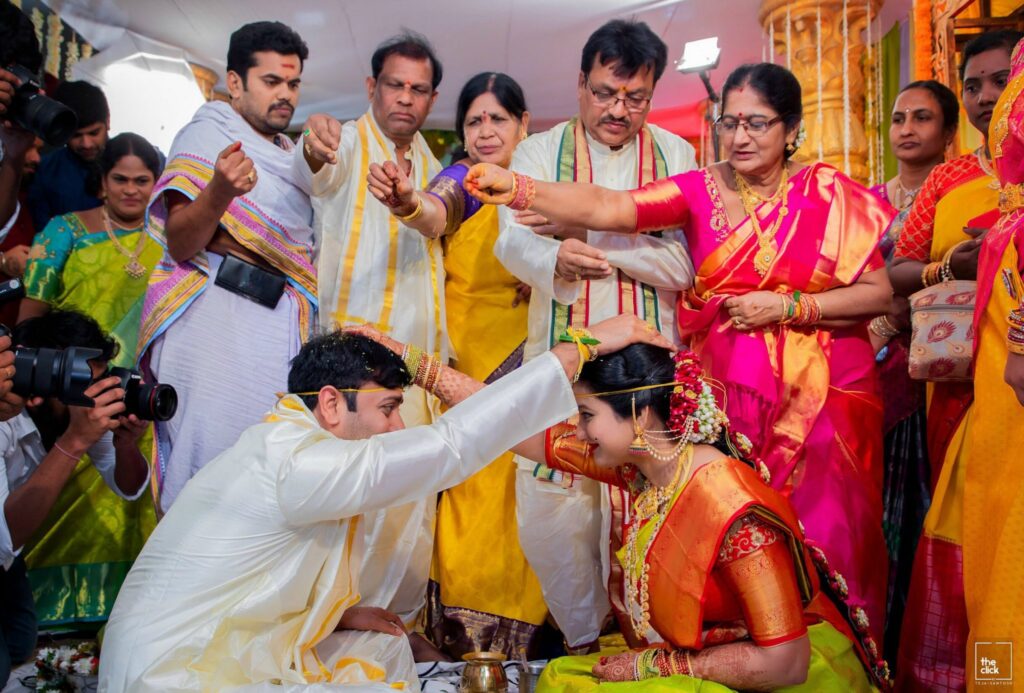
Jeelakarra Bellam is the central moment of a Telugu wedding. At the exact minute calculated by the astrologer, the priest gives the command, and the couple places a thick paste of crushed cumin seeds (Jeelakarra) and raw jaggery (Bellam) directly onto each other’s heads.
       Cumin Seeds (Bitter)  +  Raw Jaggery (Sweet)
                         │
                         ▼
        Pounded together into a thick paste
                         │
                         ▼
  Placed on crown heads simultaneously at exact Muhurtham
                         │
                         ▼
  Symbolically binds two lives across all joys and trials
In Vedic philosophy, cumin (bitter) and jaggery (sweet) combined represent life’s varied experiences. Placing this mixture on the crown chakra while pressing their hands together signifies that their minds and souls are joined to weather life’s ups and downs as one.
Only after this paste is applied is the curtain lowered, allowing the couple to see each other for the first time on the mandap.
5. Kanyadaan and Sumangali Puja
With the curtain lowered, the bride’s parents perform Kanyadaan—the solemn handing over of their daughter’s care to the groom:
- The bride places her hands in the groom’s hands.
- Her parents pour sanctified water over their joint hands, letting it stream into a brass vessel below while priests chant Vedic hymns.
- The groom pledges three times that he will respect, protect, and cherish his bride across duty (Dharma), wealth (Artha), and desire (Kama).
6. Mangalasutra Dharana (Tying the Sacred Thread)
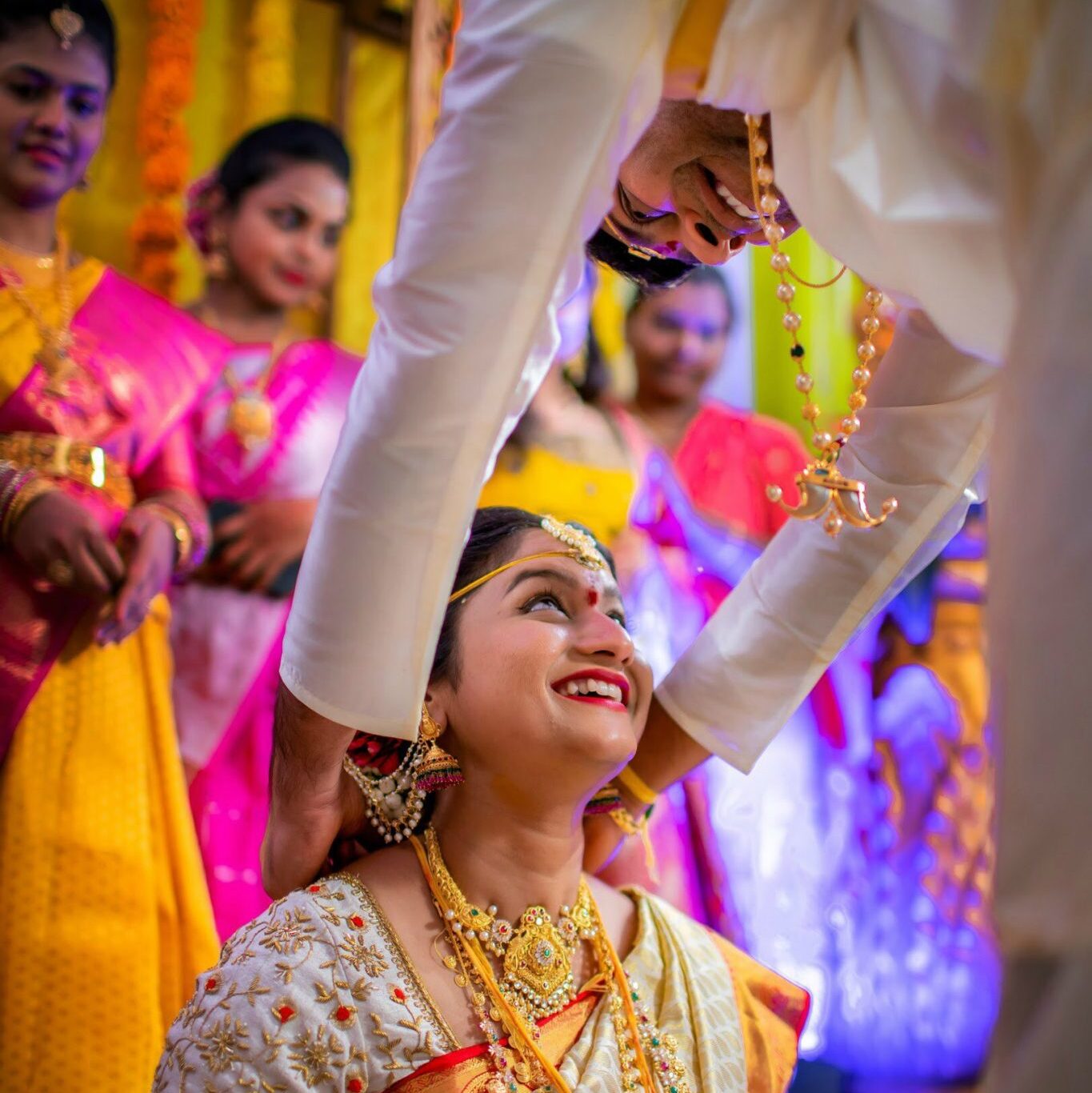
The groom takes the Mangalsutra—which consists of two small, round gold discs (Sutralu or Thaali) strung on a thick yellow thread smeared with turmeric paste—and ties it around the bride’s neck with three firm knots (Mooru Mudulu).
        DISC 1 (Paternal Lineage)  +  DISC 2 (Marital Family)
                               │
                               ▼
            Strung together on Turmeric-Dyed Thread
                               │
                               ▼
               Tied with 3 Knots (Mooru Mudulu)
        [Knot 1: Mind | Knot 2: Speech | Knot 3: Action]
Each of the three knots represents a core pillar of commitment: devotion in mind, purity in speech, and loyalty in action. The two distinct gold discs represent her natal family and her new marital family, joined as one.
7. Talambralu (The Joyous Rice Ceremony)
After the solemnity of the Mangalasutra Dharana, the mood shifts to celebration during Talambralu.
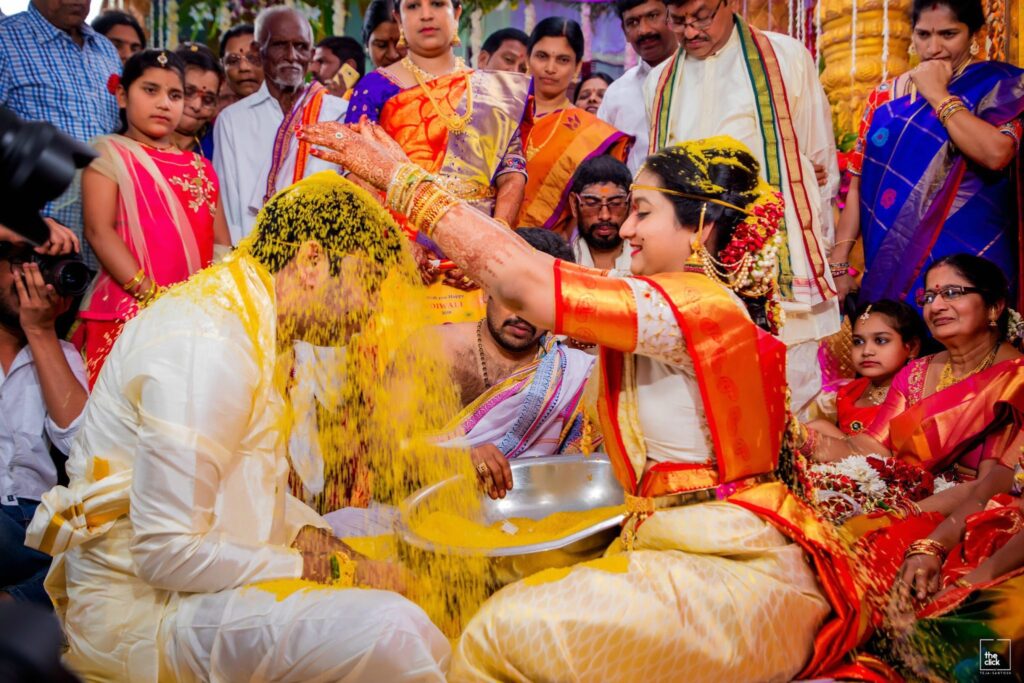
The couple is handed silver or brass bowls filled with Talambralu—raw rice coated with fresh turmeric, saffron, and aromatic rose water (or pearls and flower petals in luxury setups).
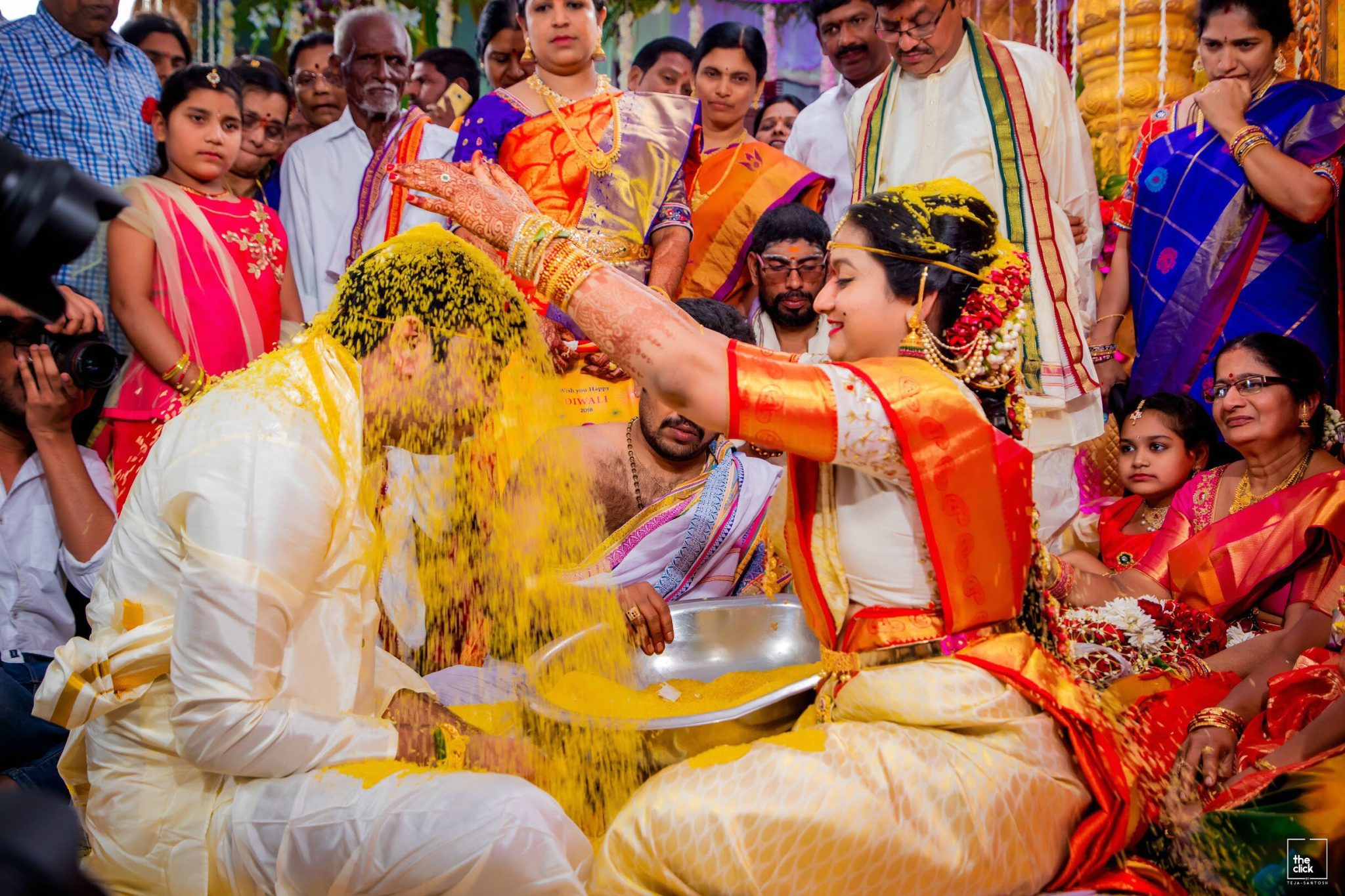
They take turns pouring handfuls of this rice over each other’s heads. What begins as a dignified exchange quickly turns into a playful competition as family members cheer, lift the couple up, and encourage them to pour the rice faster.
Phase 3: Post-Wedding Traditions & Reception
Following the main mandap rituals, post-wedding customs ease the bride’s transition into her new household.
                  ┌── 1. Saptapadi (Seven Steps Around Fire)
                  ├── 2. Arundhati Nakshatram (Star Gazing)
Post-Wedding Phase ┼── 3. Appaginthalu (Emotional Bidaai)
                  └── 4. Grihapravesam & Satyanarayana Vratam
1. Saptapadi and Arundhati Nakshatram
To finalize the legal and spiritual marriage, the couple walks seven steps together around the sacred fire (Homa), taking a distinct vow with each step:
- First Step: To provide pure and nourishing food for the household.
- Second Step: To build physical, mental, and spiritual strength.
- Third Step: To earn an honest livelihood and preserve wealth.
- Fourth Step: To nurture mutual happiness, trust, and family harmony.
- Fifth Step: To raise virtuous, healthy children.
- Sixth Step: To maintain health, longevity, and self-control.
- Seventh Step: To remain lifelong companions in truth and devotion.
Following the Saptapadi, the priest guides the couple outside the venue to view the Arundhati Nakshatram (the double star system Alcor-Mizar). In Indian astronomy, these two stars orbit around each other in complete balance—symbolizing mutual respect, devotion, and equality in marriage.
2. Appaginthalu (The Farewell)
Appaginthalu is the emotional farewell ceremony held at the end of the wedding day. The bride’s parents formally hand over their daughter to the groom’s mother and elders, asking them to guide and care for her as their own child.
Surrounded by tears and blessings, the bride bids farewell to her natal family home before leaving for her new household.
3. Grihapravesam and Ring Finding Games
Upon arriving at the groom’s ancestral home, the bride performs Grihapravesam:
- She gently kicks a small brass vessel filled with raw rice using her right foot at the entrance threshold, spilling the rice inward to symbolize bringing prosperity into the house.
- She dips her feet in a silver platter filled with milk and vermilion (Pasupu-Kumkuma), leaving red footprints on a white cloth path as she walks toward the home altar.
To break the ice and build rapport among family members, lighthearted games are played. The most popular is finding the ring: a gold ring is dropped into a large vessel filled with milk, flower petals, and water, and the couple competes to retrieve it first. Legend holds that whoever finds the ring three times will hold the upper hand in domestic decisions!
How Traditional Telugu Rituals Unfold Chronologically
Below is a typical timeline for a traditional Telugu wedding hosted over two days at a venue in Hyderabad or Andhra Pradesh.
[Day 1 Morning: Pellikuturu] ──> [Day 1 Evening: Snathakam] ──> [Day 2 Dawn: Jeelakarra] ──> [Day 2 Noon: Talambralu]
Step 1: Execute Home-Based Haldi Rites (Day 1 – 8:00 AM)
- Conduct Pellikuturu and Pellikoduku simultaneously at respective homes or separate banquet halls.
- Apply fresh turmeric paste, perform the sacred bath (Mangala Snanam), and tie the protective Kankanam wrist threads.
Step 2: Host the Evening Groom Protocols (Day 1 – 6:00 PM)
- Convene at the primary wedding convention center or hotel.
- Perform Snathakam to mark the groom’s readiness for marriage, followed by family dinner and musical entertainment.
Step 3: Begin Dawn Venue Preparations (Day 2 – 4:00 AM)
- Bride and groom arrive early at the venue for second-stage sacred baths and hair/makeup dressing.
- Mandap priests set up the sacred fire pit (Homa Kunda), align Pooja Samagri, and prepare the Tera Sella curtain.
Step 4: Welcome the Groom Procession (Day 2 – 6:30 AM)
- Execute the Edurukolu greeting at the venue entrance with garlands, rose water, and sweets.
- Lead the groom through the symbolic Kasi Yatra before escorting him up to the mandap.
Step 5: Execute the Core Muhurtham Rituals (Day 2 – 8:15 AM Exact)
- Bring the bride to the mandap in a woven bamboo basket (Pelli Butta).
- Raise the Tera Sella curtain and recite Mangalashtakam.
- Place the Jeelakarra Bellam paste on crown heads at the precise astrologically calculated minute.
Step 6: Perform Key Vows and Talambralu (Day 2 – 9:30 AM)
- Lower the curtain for the couple’s first glance, followed by Kanyadaan.
- Tie the Mangalsutra with three knots, perform Talambralu, and complete the Saptapadi seven steps around the fire.
Step 7: Step Outside for Star Gazing & Appaginthalu (Day 2 – 11:30 AM)
- Step into an open area to view the Arundhati star direction and receive blessings from elders.
- Serve a traditional vegetarian leaf feast (Panthi Bhojanam) to guests, followed by emotional Appaginthalu farewells.
4 Common Myths About Telugu Weddings
Myth 1: “Talambralu is just a photogenic game without spiritual meaning.”
Fact: While Talambralu creates wonderful photos, its roots lie in Vedic agricultural blessings. Raw rice coated with turmeric, saffron, and pearls represents prayers for fertility, prosperity, abundance, and long-term harmony.
Myth 2: “The two gold discs on the Mangalsutra can be designed in any modern style.”
Fact: Traditional Telugu customs mandate two distinct circular gold discs (Sutralu): one represents the bride’s paternal family lineage and the other represents her husband’s family line. While modern brides may change the chain after the wedding, both original discs must be present and blessed during the mandap ceremony.
Myth 3: “Jeelakarra Bellam is just a symbolic touch of food to the head.”
Fact: In South Indian tradition, applying the crushed cumin-jaggery paste directly to the crown chakra (Sahasrara) while chanting Vedic mantras is considered the exact moment marriage occurs—spiritually binding their souls before any legal paperwork or additional ceremonies.
Myth 4: “South Indian Telugu weddings must always take place at dawn.”
Fact: While many Telugu weddings take advantage of morning Godhuli or Brahma Muhurtham times, the timing depends entirely on the couple’s Lagna Patrika (astrological chart). Nighttime Muhurthams (often between 9:00 PM and 2:00 AM) are also common when astrologically indicated.
Real-World Wedding Planning Scenarios
Scenario 1: The 800-Guest Traditional Wedding in Shamshabad
- The Context: A traditional family planned an 800-guest wedding at a lawn convention center near Shamshabad, featuring a 7:30 AM Muhurtham.
- The Logistics: The team arranged two separate priest teams—one focused solely on mandap preparation while the second guided the family through Edurukolu and Kasi Yatra at the venue entrance.
- Outcome: The groom reached the mandap 20 minutes before the Muhurtham, allowing the Jeelakarra Bellam ritual to occur at the exact required minute without rushing the family.
Scenario 2: The Modern NRI Telugu Fusion Wedding in Jubilee Hills
- The Context: An NRI couple living in the US hosted a 300-guest wedding at a boutique hotel in Jubilee Hills, balancing traditional rituals with guest comfort.
- The Logistics: The family used bilingual ritual guides printed on recycled paper alongside a live digital display that explained the meaning behind Jeelakarra Bellam, Kanyadaan, and Talambralu in both English and Telugu.
- Outcome: International and non-Telugu guests were able to follow along and appreciate the ceremony, turning the 3-hour mandap event into an engaging cultural experience.
What to Look for When Planning Your Telugu Wedding
When organizing a Telugu wedding in Hyderabad or across Telangana, keeping these practical considerations in mind will help ensure a smooth event:
- Verify Your Pooja Samagri early: Work with your family priest (Siddhanthi) to create a comprehensive itemized list at least 30 days before the wedding. Arrange for specialized brass items, unblemished coconuts, and fresh mango leaves well ahead of time.
- Coordinate Timelines with Your Decorator: Ensure your decor team understands the timing of key rituals. The mandap platform must be spacious enough to comfortably seat the couple, both sets of parents, and up to three priests, with enough overhead clearance for Talambralu.
- Plan Around Muhurtham Peaks: Wedding venues across major hubs like Hyderabad, Vijayawada, and Visakhapatnam book out quickly during auspicious Lagnam dates. Reserve your venue, catering team, and lead priest 6 to 9 months in advance.
- Choose Experienced Regional Planners: Working with established local planners who understand South Indian customs can take a massive weight off your shoulders. Companies like Prashasta Events offer integrated planning, decor, and vendor coordination across Hyderabad, making sure every cultural ritual runs right on schedule.
Frequently Asked Questions
What are the traditional Telugu wedding rituals?
Traditional Telugu wedding rituals encompass pre-wedding functions like Nischithartham and Pellikuturu, sacred mandap ceremonies including Jeelakarra Bellam, Kanyadaan, Mangalasutra Dharana, and Talambralu, followed by post-wedding traditions such as Appaginthalu and Grihapravesam.
Why is Jeelakarra Bellam placed on the couple’s heads during a Telugu wedding?
Jeelakarra (cumin seeds) and Bellam (jaggery) are pounded together into a paste to symbolize the inseparable bond of marriage. Cumin is bitter and jaggery is sweet; placing them together signifies that the couple will share both the bitter and sweet moments of life in unison.
How long does a traditional Telugu wedding ceremony take?
The core main-day mandap ceremony typically lasts between 3 to 4 hours. However, when counting pre-wedding rituals like Snathakam, Mangala Snanam, and post-wedding functions, the entire traditional celebration spans 2 to 3 days.
What is the difference between a Telugu Brahmin and Reddy wedding?
While the core Vedic mantras, Jeelakarra Bellam, and Talambralu remain similar across sub-cultures, Brahmin ceremonies involve extensive Vedic chants, strict vegetarian feasts, and rituals like Snathakam. Non-Brahmin traditions like Reddy or Velama weddings may emphasize grand procession rituals, distinct feast menus, and specific regional family customs.
Why are two gold discs (Sutras) worn in a Telugu Mangalsutra?
The Telugu Mangalsutra features two round gold discs called Sutralu or Thaali. One disc represents the bride’s paternal family and lineage, while the second represents her groom’s family, symbolizing the legal and spiritual union of both families.
How much does a traditional wedding in Hyderabad cost?
A traditional wedding in Hyderabad generally ranges from ₹15 lakhs to over ₹1 crore depending on the guest count, venue choice in areas like Shamshabad or Jubilee Hills, catering choices, and custom decor requirements.
What is the significance of Talambralu in Telugu weddings?
Talambralu is a joyful ritual where the bride and groom shower each other with raw rice mixed with turmeric, saffron, or pearls. It symbolizes abundance, happiness, prosperity, and mutual respect in their shared future.
What is the Kasi Yatra ritual in a Telugu wedding?
Kasi Yatra is a lighthearted symbolic ritual where the groom pretends to renounce worldly pleasures to travel to Kasi (Varanasi) for higher learning, until the bride’s brother convinces him to marry his sister and choose the life of a householder.
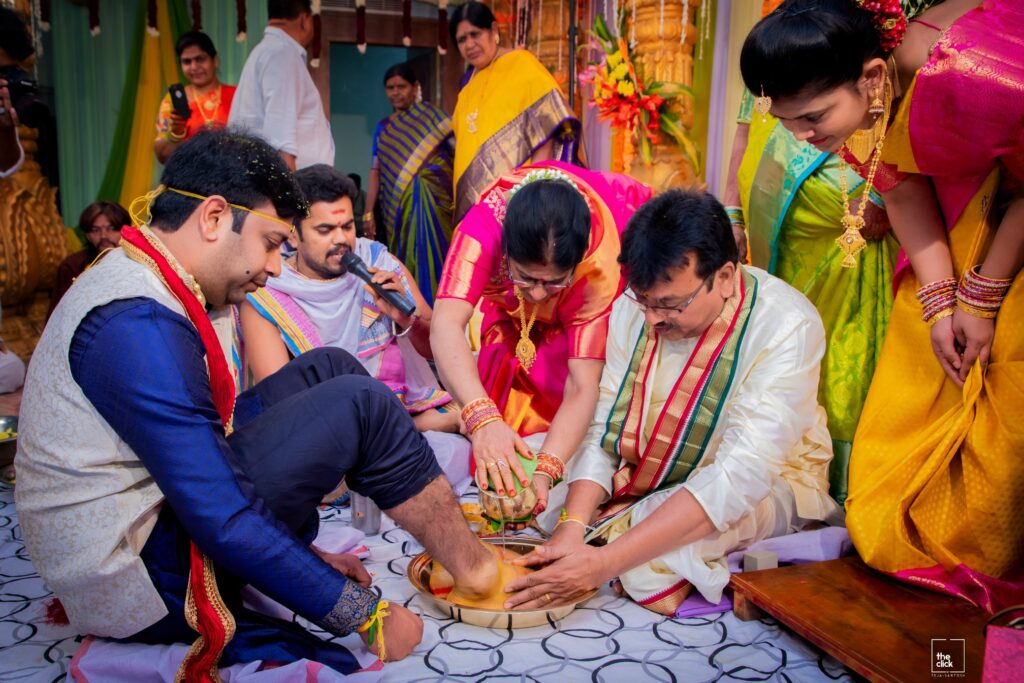
A traditional Telugu wedding is far more than a social celebration—it is a spiritual journey built on centuries of Vedic tradition, familial love, and rich symbolism. From the sacred moment cumin and jaggery are placed on the couple’s heads during Jeelakarra Bellam to the playful joy of Talambralu, each ceremony highlights the union of two families. Armed with this step-by-step understanding, you are well positioned to plan an authentic, beautiful, and culturally meaningful Telugu wedding celebration.

Leave a Comment