

Table of Contents
Traditional Telugu Wedding Planner in Hyderabad: A Complete Operational Guide
Hiring a traditional Telugu wedding planner in Hyderabad ensures that sacred Vedic Muhurthams, multi-day ceremony logistics, regional culinary protocols, and floral mandap setups are executed without timing errors or family stress. A traditional Telugu celebration (Telugu Pelli) involves intricate, time-sensitive rituals—such as Pellikuthuru, Snatakam, Kanyadaan, Jeelakarra Bellam, and Talambralu. Whether hosting a 300-guest gathering at a kalyana mandapam in Dilsukhnagar or a 1,200-guest production at a convention resort in Shamshabad, working with a specialized local planner bridges the gap between traditional family expectations and modern vendor execution.

Last Updated: October 2026
What Does a Traditional Telugu Wedding Planner Do?
A traditional Telugu wedding planner in Hyderabad is a specialized event coordinator who manages auspicious Muhurtham schedules, Vedic puja samagri procurement, traditional Panti Seva (banana-leaf) catering logistics, floral mandap construction, and multi-day venue management across pre-wedding and post-wedding rituals.
Managing a multi-day South Indian marriage requires structured operational oversight across four core planning areas:
Telugu Wedding Planning Framework
A Telugu wedding can be organized around three major planning priorities: Muhurtam and puja coordination, Panti Seva catering, and traditional mandap arrangements.
Wedding Planning Components
| Component | Budget Allocation | Key Activities |
|---|---|---|
| Muhurtam & Puja Synchronization | 25%–30% | Coordinate with the Siddhanti and plan puja samagri timing. |
| Panti Seva Catering Flow | 35%–40% | Organize banana-leaf dining and systematic guest batch rotation. |
| Traditional Mandap Construction | 25%–30% | Plan the mandap with marigold and fresh floral decorations. |
Why Families Face Challenges Planning Telugu Weddings in Hyderabad
Host families frequently run into logistical friction during multi-day Telugu celebrations by attempting to manage complex traditional ceremonies using standard, non-specialized event approaches.
- Misaligning Vendor Schedules with Early-Morning Muhurthams: Traditional Telugu weddings often center on auspicious late-night or early-morning Muhurtham hours (frequently calculated between 3:00 AM and 5:30 AM). Standard vendors accustomed to evening receptions often fail to deliver fresh garlands, hot tiffins, or lighting support during these off-peak hours.
- Mishandling Parallel Pre-Wedding Ceremonies: The Pellikuthuru (preparing the bride) and Pellikoduku (preparing the groom) ceremonies traditionally take place simultaneously at separate family homes or distinct banquet spaces, requiring dual coordination teams.
- Overlooking Traditional Sit-Down Dining Logistics: Substituting authentic sit-down banana-leaf meal service (Panti Seva) with self-serve buffets during morning ceremonies often disappoints elder relatives who expect traditional regional hospitality.
5 Essential Operational Pillars Managed by a Telugu Wedding Planner
A professional Telugu wedding planner oversees five core operational touchpoints during the event lifecycle:
5 Core Telugu Wedding Planning Pillars
A traditional Telugu wedding involves several interconnected arrangements beyond venue decoration. These five pillars help organize the cultural, ceremonial, catering, entertainment, and guest-management requirements.
Essential Wedding Planning Components
| No. | Wedding Pillar | Key Planning Activities |
|---|---|---|
| 1 | Priest (Siddhanti) & Sacred Samagri Sourcing | Coordinate with the Siddhanti, confirm ritual schedules, and arrange the required puja samagri. |
| 2 | Traditional Panti Seva Catering | Organize the banana-leaf kitchen setup, food preparation, serving teams, and dining logistics. |
| 3 | Cultural Mandap Architecture | Design the traditional mandap using marigold, jasmine, and brass decorative elements. |
| 4 | Nadaswaram Ensemble & Audio Coordination | Arrange traditional Nadaswaram musicians and coordinate audio requirements with the ceremony schedule. |
| 5 | Multi-Venue Shuttle & Guest Thamboolam Distribution | Coordinate guest transportation between venues and organize Thamboolam distribution. |
1. Priest (Siddhanti) Alignment and Puja Samagri Sourcing
The planner coordinates directly with the family priest (Siddhanti) to review birth chart requirements (Pathrika) and procure authentic ritual items—including fresh coconuts, unrefined jaggery (Bellam), cumin seeds (Jeelakarra), sacred thread (Pusti), turmeric roots, and raw clay pots (Avireni Kundalu).
2. Traditional Panti Seva Kitchen & Batch Rotations
Managing a traditional Vindhu Bhojanam served on banana leaves requires precise batch timing. The planner coordinates kitchen servers (panti servers) to ensure 100 to 150 guests are seated, served, and rotated per batch smoothly, maintaining piping-hot temperatures for dishes like Gongura Pachadi, Gutti Vankaya, Pappu Charu, and Pootharekulu.
3. Cultural Mandap Architecture and Floral Delivery
Planners design traditional mandap structures using fresh yellow marigolds (Banti Poolu), white chrysanthemums, fragrant jasmine strands, banana saplings, and polished brass oil lamps (Samai). They schedule fresh floral deliveries two hours before the ceremony to guarantee bloom fresh quality under warm venue lighting.
4. Traditional Nadaswaram Music & Stage Audio
A traditional wedding relies on continuous live acoustic accompaniment. Planners manage four-piece live Nadaswaram and Thavil ensembles, ensuring classical ragas are played during key ceremony milestones—such as the groom’s entrance, Kanyadaan, and Mangalsutra Dharana.
5. Guest Accommodations & Thamboolam Distribution
Planners oversee hotel check-in desks, local transport shuttles between venues, and the distribution of return gift bags (Thamboolam) containing betel leaves, fresh sweets, turmeric-kumkum packets, and coins as guests depart.
Telugu Wedding Planning Cost Breakdown in Hyderabad
Here is a realistic market breakdown of typical planning retainers and overall event budgets across venue tiers in Hyderabad:
| Event Scale & Tier | Typical Hyderabad Venue Types | Average Total Wedding Spend (INR) | Planner Retainer / Fee Structure |
| Intimate Traditional | AC Community Kalyana Mandapams (Dilsukhnagar, Uppal) | ₹10,000,00 – ₹18,00,000 | ₹1,20,000 – ₹2,50,000 (Fixed Management Retainer) |
| Mid-Scale Regional | Standalone Convention Centers (Kondapur, Kukatpally, Kompally) | ₹20,00,000 – ₹45,00,000 | ₹2,50,000 – ₹5,00,000 (Fixed Retainer or 10% Budget Fee) |
| Grand / Luxury | 5-Star Hotel Ballrooms & Resorts (Banjara Hills, Shamshabad) | ₹50,00,000 – ₹1,50,00,000+ | ₹5,00,000 – ₹12,00,000+ (Full Turnkey Production Fee) |
How Much Does a Wedding Planner Cost in Hyderabad?
In Hyderabad, specialized event planners structure their fees based on event duration, staff requirements, and execution complexity:
Telugu Wedding Planner Pricing Models
Wedding planners may structure their professional fees through two common pricing models: a fixed management retainer or a percentage-based fee. The suitable model depends on the scale and complexity of the wedding.
1. Fixed Management Retainer
Indicative Fee – ₹1.5–₹5 Lakhs
This model involves a predefined management fee covering:
- Vendor coordination
- Priest logistics
- Wedding timeline planning
- On-the-day event management crew
Suitable for: Weddings requiring defined planning and coordination services under a fixed fee.
2. Percentage Fee Model
Indicative Fee – 10%–14%
The planner charges a percentage of the overall wedding budget.
- Calculated as 10%–14% of the gross budget.
- Designed for multi-day luxury wedding productions.
- Suitable for events involving customized builds and more extensive production requirements.
Pricing Model Comparison
| Factor | Fixed Retainer | Percentage Fee |
|---|---|---|
| Fee Structure | ₹1.5–₹5 Lakhs | 10%–14% of gross budget |
| Cost Calculation | Predefined management fee | Based on total budget |
| Main Focus | Coordination and management | Large-scale event production |
| Suitable For | Defined planning requirements | Multi-day luxury weddings with custom builds |
- Fixed Management Retainer (₹1,50,000 – ₹5,00,000): The planner provides coordination services—managing third-party caterers, decorators, venue staff, priests, and guest hospitality—while vendors bill the family directly without hidden markups.
- Percentage-Based Fee (10% – 14% of Gross Budget): Recommended for large multi-day celebrations (500+ guests) across multiple venues, compensating the planning firm for managing large physical builds, luxury transportation fleets, and high financial liability.
Step-by-Step Guide: How to Work with Your Wedding Planner
Follow this structured framework to collaborate effectively with your planning team:
1.Step 1: Calculate Exact Muhurtham Hours with Your Siddhanti:Share birth chart (Pathrika) requirements.
Consult your family priest alongside your planner to confirm the exact auspicious Muhurtham minute and establish setup deadlines for the mandap and catering.
2.Step 2: Secure a Venue Capable of Panti Seva Dining:Select venue spaces with dual halls.
Choose a kalyana mandapam or convention hall that features a separate, spacious dining area capable of seating at least 100 to 150 guests per batch.
3.Step 3: Conduct Food Tasting Sessions with Regional Caterers:Sample traditional regional menu spreads.
Attend menu tastings with specialized Telugu caterers to finalize traditional dishes—including Pullati Majjiga, Gutti Vankaya, Gongura Royyalu/Pachadi, and Pootharekulu.
4.Step 4: Finalize Mandap 3D Renderings and Floral Budgets:Review marigold and brass prop mandap designs.
Review spatial designs for the central mandap, ensuring adequate space for the couple, parents, maternal uncles (Mama), and priests around the sacred fire.
5.Step 5: Prepare Puja Samagri and Guest Return Favors:Assemble Thamboolam favor bags.
Assemble guest return favor bags (Thamboolam) containing betel leaves, fruits, traditional sweets, and coins, storing them near the venue exit desk.
6.Step 6: Execute Day-of On-Site Event Management:Deploy floor leads for batch rotations.
Allow your planning crew to handle priest coordination, guest ushering, meal batch rotations, and transportation, leaving your family free to participate in rituals.
4 Common Myths About Hiring a Telugu Wedding Planner
Myth 1: “A wedding planner replaces the role of family elders.”
Fact: A professional planner supports family elders by handling heavy physical logistics—such as vendor follow-ups, catering refills, parking management, and power backups—allowing elders to lead sacred rituals without operational stress.
Myth 2: “Planners push families toward modern westernized setups.”
Fact: Experienced local planners specialize in traditional South Indian heritage customs. They ensure traditional elements—such as Panti Seva meals, marigold mandaps, and Nadaswaram music—are preserved with high cultural authenticity.
Generic Decorator vs. Specialized Telugu Wedding Planner
A generic decorator and a specialized Telugu wedding planner serve different roles. While a decorator primarily focuses on visual arrangements, a specialized planner coordinates traditional rituals, catering operations, and the complete multi-day wedding schedule.
Key Differences
| Generic Decorator | Specialized Telugu Wedding Planner |
|---|---|
| Focuses mainly on stage backdrops and decorations. | Coordinates the complete multi-day wedding timeline. |
| May be unfamiliar with specific puja samagri requirements. | Procures the required Vedic ritual items. |
| Does not oversee catering batch flow. | Manages Panti Seva dining rotations. |
| Typically departs after the stage setup is completed. | Remains on-site through the Appaginthalu ceremony. |
Myth 3: “In-house venue managers make an independent planner unnecessary.”
Fact: Venue managers protect property facilities and handle in-house banqueting. An independent planner works solely for the family, managing external caterers, photographers, priests, guest transport, and ritual timing.
Myth 4: “Hiring a planner is only necessary for large luxury weddings.”
Fact: Even mid-sized weddings (250–400 guests) involve multi-day logistics. Hiring a local planner prevents common issues like catering delays, missing puja items, or traffic congestion outside venues.
Real-World Telugu Wedding Scenarios
Scenario 1: A 500-Guest Traditional Wedding in Dilsukhnagar, Hyderabad
- The Profile: A traditional family hosting a classic two-day ceremony at an AC kalyana mandapam.
- The Challenge: Coordinating an early-morning 4:30 AM Muhurtham followed by a 500-guest Panti Seva breakfast.
- The Solution: The planner deployed an overnight crew to complete the marigold mandap by 2:00 AM, set up 24-hour hot beverage stations for early arrivals, and managed five smooth 100-seat dining rotations.
- The Outcome: Rituals proceeded on schedule without delays, and all guests were served fresh, hot meals.
Dilsukhnagar Telugu Wedding – Multi-Day Event Timeline
A structured wedding timeline helps coordinate pre-wedding rituals, mandap preparation, the auspicious Muhurtam, and breakfast service. The following schedule outlines the key activities across two days.
Wedding Event Schedule
| Day & Time | Event / Activity | Planning Focus |
|---|---|---|
| Day 1 – 3:00 PM | Pellikuthuru & Pre-Wedding Rituals | Coordinate traditional ceremonies and preparations. |
| Day 2 – 2:00 AM | Mandap Inspection & Fresh Flower Verification | Check mandap readiness and verify fresh floral arrangements. |
| Day 2 – 4:30 AM | Auspicious Muhurtam & Jeelakarra Bellam Ritual | Coordinate the ceremony according to the scheduled Muhurtam. |
| Day 2 – 6:30 AM | Panti Seva Breakfast Rotations | Organize breakfast service across five guest batches. |
Scenario 2: A 800-Guest Modern Telugu Wedding in Shamshabad
- The Profile: An urban family hosting a traditional morning ceremony inside an AC hall, followed by a grand evening reception on an outdoor resort lawn.
- The Solution: The planner managed two distinct setups simultaneously—a traditional floral mandap inside the hall for morning rituals and an audio-visual stage with live food counters on the lawn for the evening reception.
- The Outcome: Both events transitioned seamlessly, allowing the family to enjoy both traditional and modern celebration formats.
Traditional Telugu Wedding Operational Checklist
Review this practical checklist with your planner prior to your event dates:
- [ ] Priest (Siddhanti) Confirmation: Is the priest provided with a detailed timeline, and is the complete samagri list double-checked?
- [ ] Catering Batch Setup: Are there enough serving staff (panti servers) confirmed for banana-leaf meal rotations?
- [ ] Fresh Flower Delivery Timing: Are fresh marigolds, jasmine, and lotus garlands scheduled to arrive 2 hours before the ceremony?
- [ ] Nadaswaram Ensemble Readiness: Are traditional musicians scheduled to arrive 1 hour before guest arrivals?
- [ ] Thamboolam Return Gifts: Are return favor bags packed, counted, and positioned near the exit desk?

Frequently Asked Questions
What does a traditional Telugu wedding planner do in Hyderabad?
A Telugu wedding planner manages multi-day event logistics, priest coordination, Vedic puja samagri procurement, traditional Panti Seva (banana-leaf) catering flow, floral mandap builds, and guest hospitality.
How much does a wedding planner cost in Hyderabad?
Fixed management retainers for mid-sized traditional weddings range from ₹1,50,000 to ₹3,50,000. Full-service percentage fees for large multi-day weddings range between 10% and 14% of the total budget.
What is the most important ritual managed during a Telugu wedding?
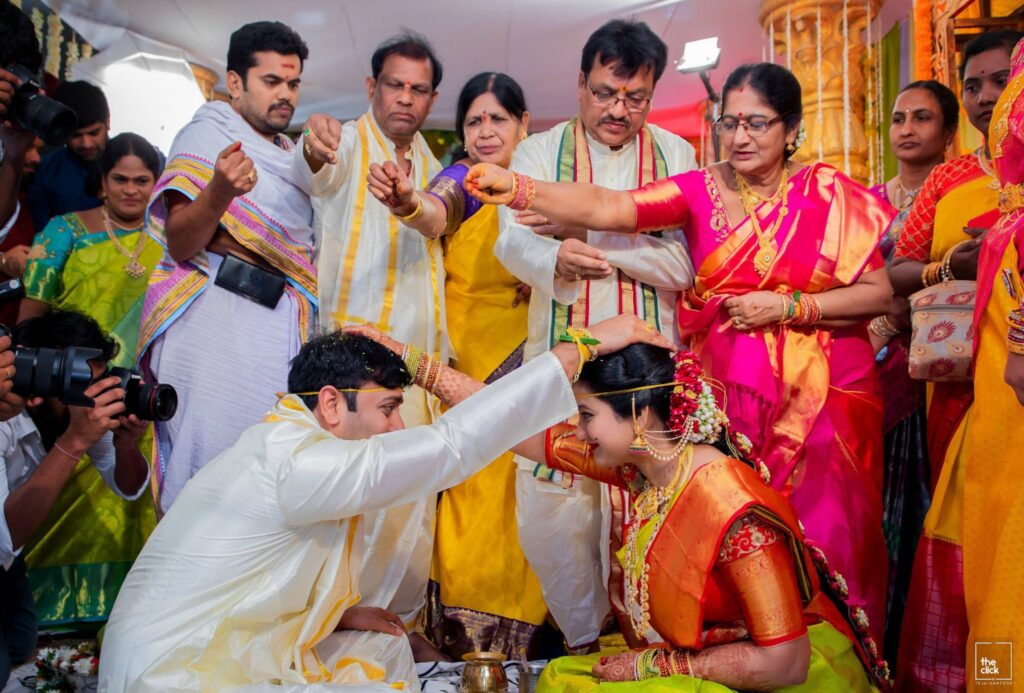
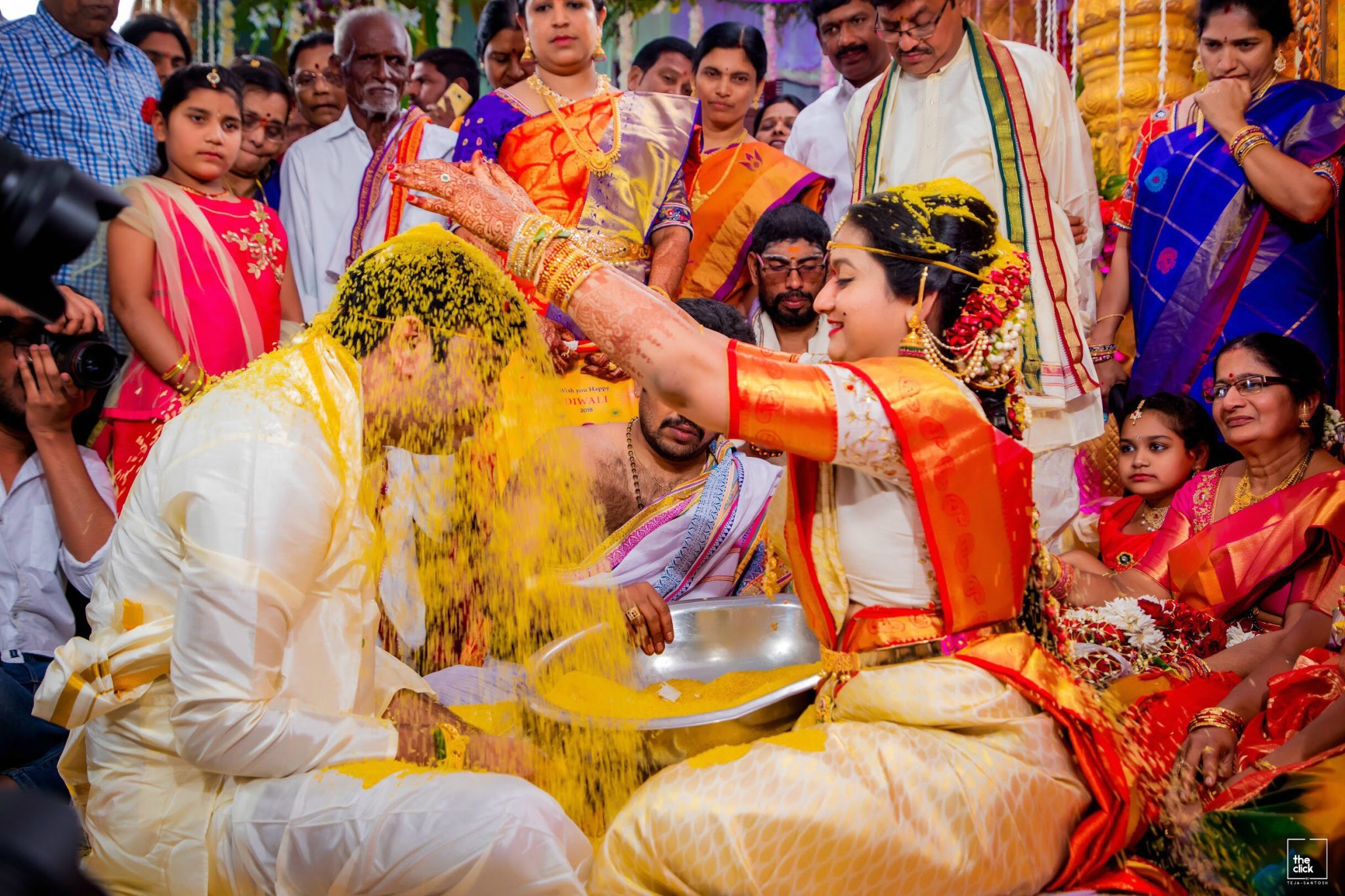
The Jeelakarra Bellam moment is the central Muhurtham ritual. At the exact astrologically calculated minute, the couple places a paste of cumin seeds and jaggery on each other’s crowns, marking their spiritual union.
How do planners manage sit-down banana-leaf meals (Panti Seva)?
Planners organize dining spaces into structured seating rows, coordinating kitchen servers to serve dishes in traditional sequence and managing fast batch rotations to keep food fresh and hot.
How early should I book a Telugu wedding planner in Hyderabad?
Book your planner 6 to 9 months in advance, especially for peak Shubha Muhurtham dates (November through February and April through June) when popular venues and caterers fill quickly.
What is included in a traditional Telugu wedding feast (Vindhu Bhojanam)?
A traditional feast served on a banana leaf features regional items such as rice, Pappu, Gongura Pachadi, Gutti Vankaya curry, Pulihora, Sambar, Rasam, Curd, Pootharekulu, Bobbatlu, and Vada.
Can a planner help manage simultaneous pre-wedding ceremonies?
Yes. Planners deploy separate operational leads to manage simultaneous pre-wedding functions—such as Pellikuthuru at the bride’s location and Pellikoduku at the groom’s location—ensuring both run smoothly.
What is the difference between a wedding decorator and a wedding planner?
A decorator handles visual setups, staging, and floral arrangements. A wedding planner oversees full event execution—including vendor contracts, catering flow, priest coordination, guest transport, and timeline management.
Working with a traditional Telugu wedding planner in Hyderabad ensures that sacred Vedic customs, guest hospitality, and multi-day venue logistics are executed smoothly. By organizing timelines around precise Muhurtham hours, coordinating authentic Panti Seva dining, and managing traditional floral aesthetics, you can enjoy a stress-free celebration with your family. Equipped with these practical operational insights, you are well prepared to select the right planning partner for your wedding day.



Leave a Comment