
Table of Contents
What Is the Typical Timeline for a Telugu Wedding in Hyderabad? A Complete Planning Guide
Understanding what is the typical timeline for a Telugu wedding requires examining how sacred Vedic astrological hours (Shubha Muhurtham), multi-day ceremony preparations, traditional banana-leaf dining (Panti Seva), and modern reception logistics interlock over a 2-to-3-day window. In major Telangana wedding hubs like Hyderabad, where celebrations range from intimate 300-guest functions at community kalyana mandapams in Dilsukhnagar to 1,000-guest gatherings in Shamshabad or Kondapur, managing this timeline protects the cultural purity of rituals while keeping family stress low. From pre-wedding rituals like Pellikuthuru and Snatakam to the core Jeelakarra Bellam and post-wedding Appaginthalu, a well-organized schedule ensures every event unfolds without delay.
Last Updated: November 2026
What Is the Overview Sequence of a Telugu Wedding Timeline?
A typical Telugu wedding timeline spans 2 to 3 days across three main phases: Pre-Wedding (Nischayartham, Pellikuthuru, Snatakam, Mehendi/Sangeet), Main Wedding Day (Kasi Yatra, Mangala Snanam, Kanyadaan, Jeelakarra Bellam, Thali Dharana, Talambralu), and Post-Wedding (Appaginthalu, Reception, Satyanarayana Vratam).
Structuring a multi-day Telugu marriage requires aligning Vedic timing with physical venue availability across distinct ceremonial phases.
3-Phase Telugu Wedding Timeline
Phase 1: Pre-Wedding (Days 1 & 2)
- Pellikuthuru ceremony
- Snatakam ceremony
- Mehendi function
- Sangeet celebration
Phase 2: Main Wedding (Day 2 or Day 3)
- Kanyadaanam
- Jeelakarra Bellam ceremony
- Thali Dharana
- Talambralu ceremony
Phase 3: Post-Wedding (Days 3 & 4)
- Appaginthalu ceremony
- Wedding reception
- Satyanarayana Vratam
Why Families Face Timeline Chaos in Telugu Weddings
Host families frequently encounter timing breakdowns during multi-day Telugu celebrations by misjudging ritual durations and vendor coordination needs.
- Misjudging Early-Morning Muhurtham Constraints: Sacred Shubha Muhurthams often fall during early-morning hours (such as 3:30 AM to 5:15 AM). Failing to account for late-night vendor loading, fresh flower delivery from markets like Gudimalkapur, or early bridal makeup leads to delayed stage entries.
- Overlooking Parallel Pre-Wedding Logistics: Running Pellikuthuru (preparing the bride) and Pellikoduku (preparing the groom) simultaneously at separate family homes or banquet halls requires dual management teams to keep both sides synchronized.
- Miscalculating Sit-Down Dining Rotations: Serving traditional banana-leaf meals (Panti Seva) to 500 guests requires 4 to 5 batches. If each batch takes 40 minutes, catering spans nearly 3.5 hours, which must be factored into the overall venue timeline.
The 3-Day Chronological Telugu Wedding Master Timeline
A classic Telugu wedding (Telugu Pelli) follows a well-defined sequence across three core planning phases:
Day 1: Nischayartham & Initial Preparations
- Formal Engagement (Nischayartham): The families exchange written invitation cards (Lagnapatrika), clothes, and sweets, confirming the upcoming wedding date approved by the family priest (Siddhanti).
- Venue Teardown & Setup Loading: Decorators begin erecting heavy steel structures, wooden stage decking, and background frames at the main kalyana mandapam.
Day 2 (Morning): Pellikuthuru, Pellikoduku & Snatakam
- 07:00 AM – 10:30 AM (Pellikuthuru / Pellikoduku): Held at respective family locations. Turmeric paste (Nalugu), aromatic oils, and flowers are applied to the bride and groom, followed by traditional gifts of silk sarees and dhotis.
- 10:30 AM – 12:30 PM (Snatakam): The groom performs the Snatakam ceremony, symbolizing his completion of basic education and readiness to enter householder life (Grihastha Ashram).
Day 2 (Evening): Mehendi, Sangeet & Pre-Wedding Celebrations
- 04:00 PM – 07:00 PM (Mehendi): Henna application for the bride and female relatives, accompanied by high-tea counters.
- 07:30 PM – 10:30 PM (Sangeet Night): Choreographed family dances, musical performances, and live buffet spreads. In Hyderabad, outdoor lawn sound curfews require moving DJ music indoors by 10:00 PM.
Detailed Breakdown of the Main Wedding Day (Day 3)
The main ceremony day requires tight operational discipline, especially when working around precise astrological timings.
Telugu Wedding – Main Ceremony Hour-by-Hour Schedule
– 3 Hours Before Muhurtham: Vendors complete their arrangements, fresh flowers are delivered, and the bride’s makeup begins.
– 1.5 Hours Before Muhurtham: Kasi Yatra takes place, followed by the groom’s welcome (Edurukolu).
– 30 Minutes Before Muhurtham: The bride arrives on the stage, and the Addutera (silk curtain) is arranged.
– At Muhurtham: Jeelakarra Bellam ceremony takes place.
– 30 Minutes After Muhurtham: Mangalsutra Dharana (Thali tying ceremony).
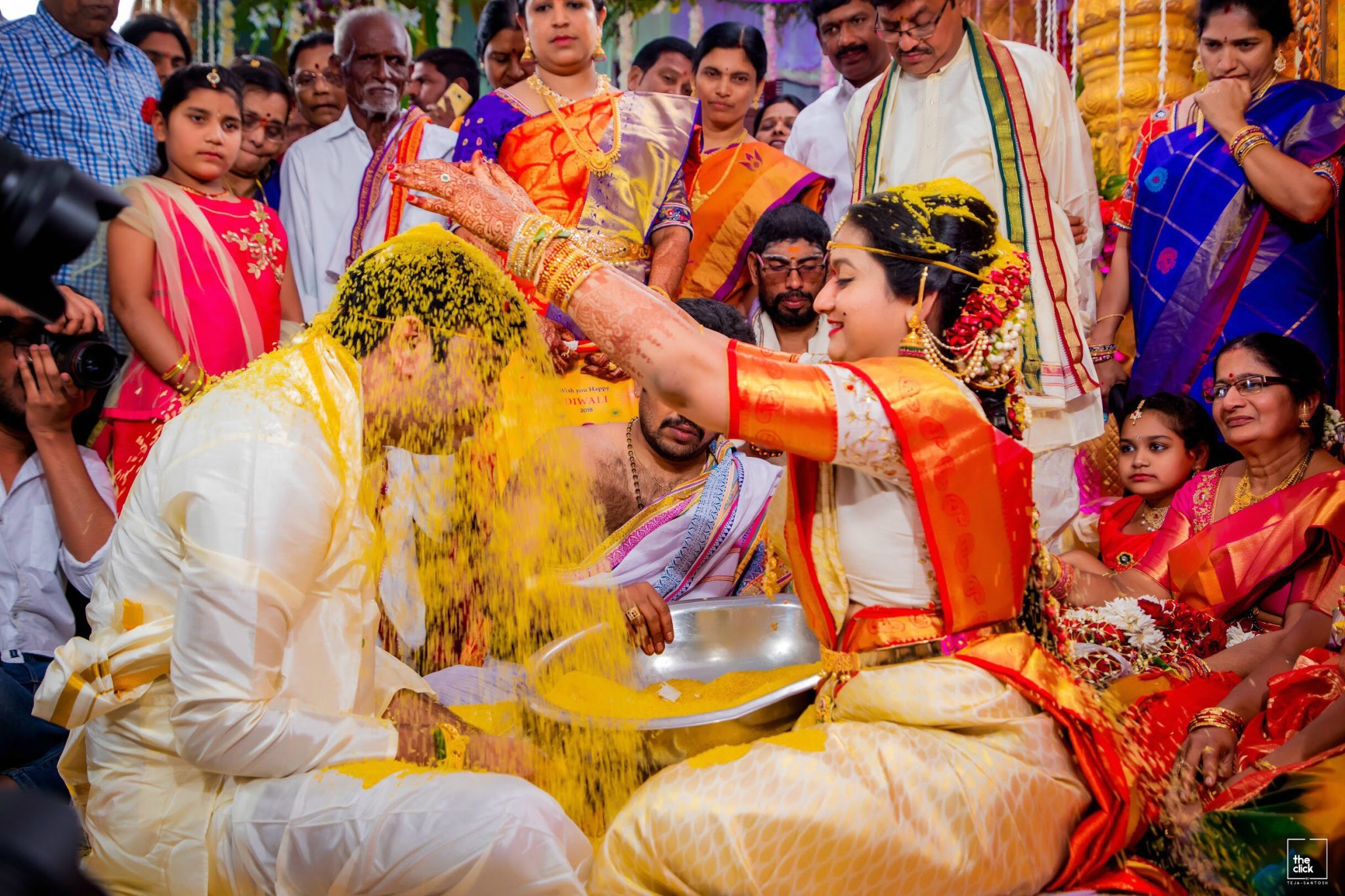
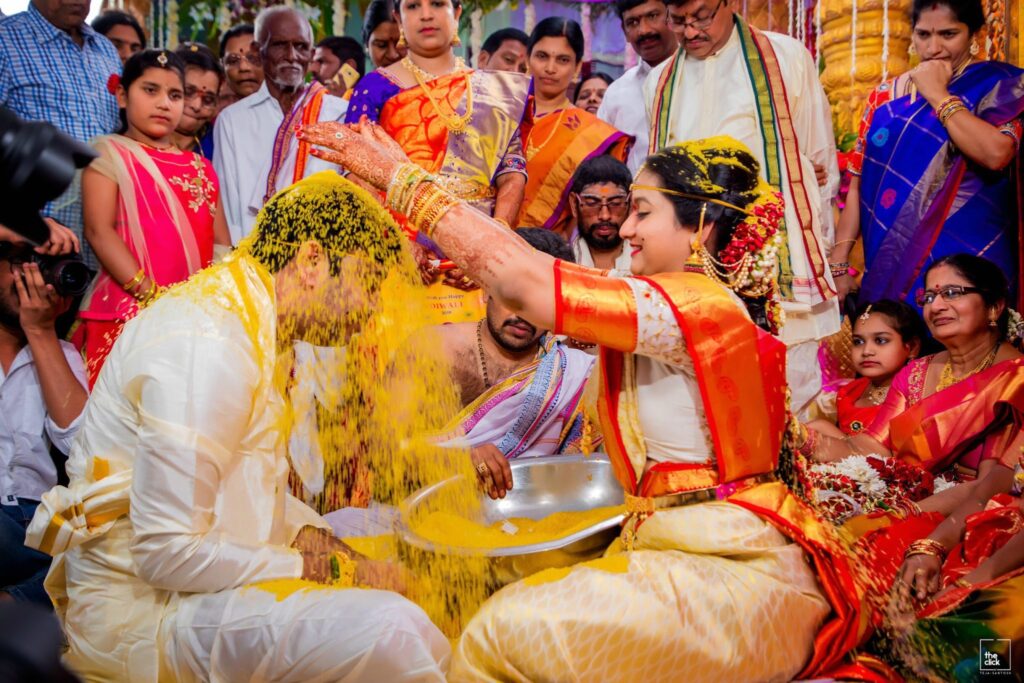
– 1 Hour After Muhurtham: Talambralu ceremony, where the bride and groom shower each other with rice and turmeric.
– 2 Hours After Muhurtham: Saptapadi (seven steps) followed by the traditional Panti Seva feast.
1. Kasi Yatra and Groom’s Entrance (Edwuru-Kolu)
The groom symbolically pretends to embark on a pilgrimage to Kasi, only to be persuaded by the bride’s brother to assume family responsibilities. The bride’s family then welcomes the groom to the mandap with traditional music (Nadaswaram) and floral garlands.
2. Addutera and Kanyadaan
The bride is escorted to the mandap by her maternal uncles (Mama). A hand-woven silk curtain (Addutera) is placed between the bride and groom, keeping them separated while priests chant Vedic mantras. The bride’s parents then perform Kanyadaan, entrusting their daughter to the groom.
3. Jeelakarra Bellam (The Muhurtham Minute)
At the exact auspicious minute, the Addutera remains raised as the couple places a sacred paste of ground cumin seeds (Jeelakarra) and unrefined sugar (Bellam) on each other’s crowns. This act symbolizes eternal union and marks the official marriage moment.
4. Mangalsutra Dharana and Talambralu
The groom ties the sacred thread (Pusti / Mangalsutra) around the bride’s neck, secured with three knots. Next, the curtain is lowered for Talambralu, a joyful custom where the couple showers each other’s heads with pearls, flower petals, and turmeric-dyed rice.
5. Saptapadi and Traditional Panti Seva Feast
The couple takes seven sacred steps (Saptapadi) around the holy fire (Homa Kunda), taking vows of companionship. Guests are then ushered to the dining hall for a traditional South Indian banana-leaf meal featuring dishes like Gongura Pachadi, Gutti Vankaya, Pappu Charu, Pulihora, and Pootharekulu.
Stage Ritual vs. Dining Timeline Comparison Table
Managing a Telugu wedding requires balancing formal stage rituals with dining hall capacity:
| Time Phase | Main Stage Ceremonial Action | Kitchen & Dining Hall Action | Primary Operational Focus |
| 03:30 AM – 04:30 AM | Groom entry, Kasi Yatra, Addutera placement | Hot beverage counters active (Coffee, Tea, Badam Milk) | Welcoming early-morning guests; verifying lighting setups |
| 04:30 AM – 05:15 AM | Jeelakarra Bellam (Muhurtham) & Thali Tying | Kitchen fires initial breakfast tiffins (Idli, Vada, Upma) | Quiet reverent focus during sacred Vedic chants |
| 05:15 AM – 07:00 AM | Talambralu, Saptapadi, & Family Stage Photos | Breakfast dining hall opens; high-speed batch serving | Managing photo stage queues; seating breakfast batches |
| 11:30 AM – 03:00 PM | Optional Post-Muhurtham Blessings / Rest | Full Panti Seva lunch service (4 to 5 Rotations) | Directing batch seating; ensuring hot food refills |
| 07:00 PM – 10:30 PM | Evening Reception Stage Setup & Couple Entrance | Multi-cuisine evening buffet & live food stalls | Managing evening guest flow; monitoring DJ curfews |
Step-by-Step Guide: How to Structure Your Master Telugu Wedding Timeline
Follow this operational step-by-step framework to map out your multi-day event timeline:
1.Step 1: Calculate Auspicious Muhurtham Hours with Your Siddhanti: Consult your family priest 6 months in advance.
Meet with your family priest (Siddhanti) to confirm the exact Shubha Muhurtham date and time based on birth charts (Pathrika). Establish hard setup deadlines for decor and catering.
2.Step 2: Lock Multi-Day Venue Access and Buffer Hours: Ensure adequate venue loading and setup windows.
Book your kalyana mandapam or convention hall with generous setup buffers. Confirm the hall allows overnight decor setup for early-morning ceremonies.
3.Step 3: Schedule Pre-Wedding Ceremonies (Days 1 & 2): Set fixed start and end times for pre-wedding functions.
Plan Pellikuthuru, Pellikoduku, Snatakam, and Sangeet routines with built-in 30-minute buffers to absorb minor makeup or transit delays.
4.Step 4: Script the Main Wedding Day Sequence (Day 3): Script the main ceremony hour by hour.
Draft a minute-by-minute timeline covering vendor loading dock arrivals, priest requirements, Addutera placement, Jeelakarra Bellam, and Talambralu.
5.Step 5: Coordinate Panti Seva Catering Rotations: Coordinate kitchen batch firings with hall capacity.
Align kitchen serving crews with dining hall seating capacity (e.g., 100–150 seats per batch) to ensure smooth dining rotations without long guest queues.
6.Step 6: Plan Post-Wedding Transitions and Appaginthalu: Plan emotional farewells and post-wedding rituals.
Organize the emotional farewell ceremony (Appaginthalu), arrange luggage transport, and schedule post-wedding rituals like Satyanarayana Vratam.
4 Common Myths About Telugu Wedding Timelines
Myth 1: “All guests will arrive for early-morning Muhurthams.”
Fact: While immediate family members and close elders attend 4:00 AM Muhurthams, distant relatives and friends typically arrive later during morning breakfast hours (7:00 AM to 9:00 AM) or the evening reception.
Myth 2: “Stage rituals can be compressed into 30 minutes.”
Fact: Authentic Vedic rituals—including Kanyadaan, Jeelakarra Bellam, Thali Dharana, Talambralu, and Saptapadi—require at least 2.5 to 3.5 hours on stage to complete with proper Vedic chanting.
Rushed Wedding Schedule vs. Traditional Vedic Wedding Flow
| Rushed Wedding Schedule | Traditional Vedic Wedding Schedule |
|---|---|
| Shortened Vedic mantras and rituals | Complete ritual chanting guided by the Siddhanti (priest) |
| Talambralu performed quickly for photographs | Enough time for Talambralu and Saptapadi rituals |
| More stress for the couple and family elders | Relaxed participation from family members |
| Limited time for traditional photographs | Enough time for rituals, family moments and photographs |
Myth 3: “The reception must occur on the exact same day as the Muhurtham.”
Fact: If the main Muhurtham takes place during early-morning hours (e.g., 4:00 AM), families often schedule the grand reception on the evening of the same day or the following evening to allow the couple and guests time to rest.
Myth 4: “Traditional timelines leave no room for modern events like Sangeets.”
Fact: Modern Telugu weddings easily integrate contemporary celebrations. Scheduling a high-energy Sangeet on the evening of Day 2 balances traditional morning rituals with modern entertainment.
Real-World Timeline Scenarios
Scenario 1: A 500-Guest Traditional Wedding in Dilsukhnagar, Hyderabad
- The Profile: A traditional family hosting a multi-day ceremony at an AC kalyana mandapam with an early-morning 4:45 AM Muhurtham.
- The Timeline Strategy: Decor setup completed by 2:00 AM. 24-hour hot beverage stations opened at 3:30 AM for early arrivals. Jeelakarra Bellam took place at 4:45 AM, followed by Talambralu at 5:45 AM and five Panti Seva breakfast rotations starting at 6:30 AM.
- The Outcome: Rituals proceeded on schedule, and all 500 guests were served efficiently.
Dilsukhnagar Early-Morning Wedding Schedule
- 02:00 AM: Final mandap inspection and fresh flower arrangements check.
- 03:30 AM: Guests arrive, and hot tea and coffee counters open.
- 04:45 AM: Main Muhurtham and Jeelakarra Bellam ceremony.
- 05:45 AM: Talambralu and Saptapadi rituals.
- 06:30 AM: Traditional Panti Seva breakfast served in 5 batches.
Scenario 2: A 800-Guest Combined Muhurtham and Reception in Shamshabad
- The Profile: An urban family hosting an 8:30 AM morning wedding inside an AC convention hall, followed by a 7:00 PM resort lawn reception.
- The Timeline Strategy: Morning rituals ran from 8:30 AM to 11:30 AM, followed by a 4-batch Panti Seva lunch. The stage was restyled between 2:00 PM and 6:00 PM for the evening reception and DJ sets.
- The Outcome: The day flowed smoothly without schedule conflicts.
Master Timeline Inspection Checklist
Review this practical checklist with your family lead or coordinator 2 weeks before your event:
- [ ] Priest Timeline Confirmation: Has your family priest (Siddhanti) verified the exact minute for Jeelakarra Bellam and stage setup deadlines?
- [ ] Venue Access Hours: Is the kalyana mandapam booked with sufficient setup time for overnight decor work?
- [ ] Catering Service Schedule: Are kitchen batch firings synchronized with your dining hall’s seating capacity?
- [ ] Fresh Flower Delivery Window: Are fresh marigold and jasmine garlands scheduled to arrive 2 hours prior to ceremony start times?
- [ ] Vendor Contact List: Have all vendor leads received a printed copy of the minute-by-minute run-of-show script?
Frequently Asked Questions
How many days does a traditional Telugu wedding take?
A traditional Telugu wedding typically spans 2 to 3 days. Pre-wedding rituals like Pellikuthuru, Snatakam, and Sangeet occur on Days 1 and 2, followed by the main Muhurtham ceremony and reception on Day 2 or 3.
What is the most critical ceremony timing in a Telugu wedding?
The Jeelakarra Bellam ritual is the core astrological moment. At the exact calculated Muhurtham minute, the bride and groom place a paste of cumin seeds and jaggery on each other’s crowns to seal their spiritual union.
Why do many Telugu weddings happen early in the morning?
Auspicious planetary alignments (Shubha Muhurtham) determined by planetary charts often fall during early-morning hours, such as between 3:00 AM and 5:30 AM (Brahma Muhurtham).
How long does the main Telugu wedding ceremony last on stage?
The main stage Vedic rituals—from Kasi Yatra and Mangala Snanam through Jeelakarra Bellam, Thali Dharana, Talambralu, and Saptapadi—typically last between 2.5 and 4 hours.
How far in advance should I book vendors for a Telugu wedding in Hyderabad?
Book key venues, caterers, decorators, and photographers 6 to 9 months in advance, especially if your dates fall within peak Shubha Muhurtham clusters.
What is the difference between Pellikuthuru and Snatakam?
Pellikuthuru is the ceremony where the bride is anointed with turmeric, oil, and flowers by female relatives. Snatakam is a groom’s ritual signifying his readiness to complete bachelorhood and assume householder duties.
How do you manage catering timelines for early-morning Muhurthams?
Caterers set up 24-hour hot beverage stalls (coffee, tea, badam milk) for early arrivals, followed by full South Indian breakfast tiffins starting immediately after the Muhurtham minute.
What is the Appaginthalu ritual?
Appaginthalu is the traditional farewell ceremony held at the end of the wedding, where the bride’s family formally entrusts her to the groom and his parents.
Understanding what is the typical timeline for a Telugu wedding comes down to balancing sacred Vedic timings, multi-day ritual preparations, and vendor execution. By organizing your schedule around precise Muhurtham hours, coordinating Panti Seva meal rotations, and building buffer times into each ceremony, you can host a memorable, stress-free wedding. Equipped with these practical timeline insights, you are well prepared to plan a smooth celebration for your family.



Leave a Comment