
Table of Contents
Telugu Wedding Accessories Checklist: Essential Items for Hyderabad Ceremonies
Preparing a Telugu wedding accessories checklist requires balancing sacred ritual items, heritage gold jewelry, intricate floral hair pieces, and specific groom attire across multiple ceremony phases. Traditional Telugu weddings—whether hosted in an established venue in Secunderabad or a grand convention hall in Madhapur—are guided by detailed Vedic rituals. From the initial Pellikuthuru or Pellikoduku ceremony to the central Jeelakarra Bellam moment, missing a key item like a carved Kobbari Bonda (decorated coconut) or sacred Pasupu-Kumkum tray can interrupt the flow of the ceremony.
A complete checklist organizes physical items by event phase: bridal jewelry and floral pieces (Poola Jada), groom essentials (Pancha-Kanduva set), ritual pooja samagri, and ceremonial mandap props. Categorizing items by ritual helps families ensure that everything from heirloom Vaddanam belts to silver Metti toe rings is packed, tracked, and ready on time.

What is a Telugu Wedding Accessories Checklist?
A Telugu wedding accessories checklist is an organized inventory of sacred, ornamental, and functional items required across traditional Andhra and Telangana wedding rituals. It spans five major categories: bridal ornaments (Vaddanam, Papidi Billa), groom attire accessories (Kanduva, Uttareeyam), sacred ritual elements (Jeelakarra Bellam, Mangalsutra/Pustelu), floral accessories (Poola Jada), and mandap props (Addutera, Kobbari Bonda).
┌─────────────────────────────────────────────────────────────────────────────┐
│                 TELUGU WEDDING ACCESSORIES CATEGORY MATRIX                  │
├──────────────────────────────┬──────────────────────────────┬───────────────┤
│ RITUAL CATEGORY              │ CORE ACCESSORY ITEMS         │ TIMELINE      │
├──────────────────────────────┼──────────────────────────────┼───────────────┤
│ Bridal Heritage Ornaments    │ Vaddanam, Kasu Haram, Mattilu│ 2 to 4 Months │
│ Groom Traditional Wear       │ Silk Pancha, Kanduva, Metti  │ 1 to 2 Months │
│ Sacred Pooja Samagri         │ Pasupu, Kumkum, Akshatalu    │ 2 to 3 Weeks  │
│ Fresh Floral Accessories     │ Poola Jada, Garlands         │ 1 to 3 Days   │
│ Mandap Stage Props           │ Addutera, Decorated Coconuts │ 1 to 2 Weeks  │
└──────────────────────────────┴──────────────────────────────┴───────────────┘
Why a Detailed Accessories Checklist Matters in Hyderabad Weddings
Telugu wedding ceremonies are time-sensitive, often centered around an exact, auspicious Sumuhurtham calculated down to the minute by family astrologers. When ceremony items are missing or misplaced across changing rooms, families face unnecessary stress during important rituals.
Unstructured Accessories Handling       Structured Checklist Execution
├── Missing Addutera cloth at mandap   ├── Pre-packed stage prop kit assigned
├── Misplaced Pustelu gold beads       ├── Secured jewel pouch with custodian
├── Wilting Poola Jada on arrival      ├── Temperature-managed floral delivery
└── Delayed Jeelakarra Bellam paste    └── Pre-mixed ritual plates ready
Common issues when accessories are managed without a checklist include:
- Ritual Delays: Searching for specific items—such as fresh betel leaves (tamalapaku), brass hand-wash bowls, or raw turmeric roots (pasupu kommu)—during high-priority rituals can cause delays during the Sumuhurtham.
- Jewelry Incompatibilities: Discovering that the Vaddanam (waist belt) hook doesn’t fit the saree pleats or that heavy Jhumkas lack supporting side chains (Mattilu) on the morning of the wedding creates unnecessary friction.
- Floral Wilting: Failing to coordinate same-day delivery for fresh flower accessories like the Poola Jada or heavy rose-and-jasmine garlands can result in wilted flowers under hot stage lights.
- Loss of Heirloom Items: Moving small, high-value gold and silver items—such as the Pustelu (holy lockets) or silver toe rings—between hotel suites and venue changing rooms increases the risk of misplacement.
The 5 Core Pillars of a Telugu Wedding Accessories Checklist
To keep your preparations clear and organized, group your checklist items into five primary categories.
                          ┌── 1. Traditional Bridal Jewelry & Hair Items
                          ├── 2. Groom Attire & Ritual Accessories
Telugu Wedding Checklist ─┼── 3. Sacred Pooja Samagri & Ritual Utensils
                          ├── 4. Mandap Props & Ceremony Textiles
                          └── 5. Fresh Floral & Decorative Extras
1. Traditional Bridal Jewelry and Hair Accessories
Telugu bridal attire relies on classic gold and gemstone ornaments that provide structure and balance to heavy Kanjeevaram silk sarees.
- Head and Hair Ornaments:
- Papidi Billa / Nethichutti (Maang Tikka): Placed along the central hair parting, featuring temple gold, Kundan, or uncut diamond craftsmanship.
- Chandra and Surya Pins: Traditional moon and sun-shaped gold pins secured on either side of the hair crown.
- Jada Billalu: A series of 7 to 9 circular gold or temple-style clips attached down the length of the hair braid.
- Neck and Ear Jewelry:
- Kasu Haram: A traditional gold coin necklace featuring engraved images of Goddess Lakshmi.
- Guttapusalu: A classic coastal Andhra necklace trimmed with clusters of small rice pearls.
- Jhumkas with Mattilu: Heavy dangling earrings supported by multi-layered gold side chains (mattilu) pinned into the hair to ease earlobe strain.
- Waist and Arm Accessories:
- Vaddanam: A structured gold waist belt that holds saree pleats neatly in place. Choose an adjustable waist belt to ensure comfort while sitting during long rituals.
- Aravanki (Vanki): V-shaped upper arm bands set with rubies, emeralds, or polki stones.
- Hand and Feet Accents:
- Kankanalu & Bangles: Solid gold bangles paired with green or red glass bangles.
- Metti (Silver Toe Rings): Placed on the second toe by the groom during the final marriage rituals.
2. Groom Attire and Ritual Essentials
While groom wear appears straightforward, traditional Telugu ceremonies require specific ethnic textiles and functional accessories.
- Ceremonial Textiles:
- Pancha & Kanduva: Pure handloom silk or high-count cotton dhoti set with rich zari borders for the main Muhurtham.
- Uttareeyam: A formal upper cloth draped over the shoulder during Vedic chants.
- Ritual Accessories:
- Pelli Pusthakam & Staff: Traditional carved wooden staff and book used during the playful Kasi Yatra ceremony, where the groom pretends to set off for Varanasi before being persuaded to choose family life.
- Safa or Silk Turban: A hand-tied silk headpiece adorned with a subtle brooch (Kalgi).
- Traditional Footwear: Handcrafted leather juttis for venue arrivals, easily removed before stepping onto the sacred mandap.
3. Sacred Pooja Samagri and Ritual Utensils
Every step of a Telugu wedding involves specific organic elements and sacred metal items.
┌───────────────────────────┬───────────────────────────────────┬────────────────────────────────┐
│ Samagri Item              │ Cultural Significance / Use       │ Storage & Sourcing Requirement │
├───────────────────────────┼───────────────────────────────────┼────────────────────────────────┤
│ Jeelakarra Bellam Paste   │ Cumin + Jaggery paste for head    │ Mix fresh 30 mins before       │
│                           │ placement at Sumuhurtham          │ Sumuhurtham                    │
│ Pasupu & Kumkum           │ Fresh turmeric & vermilion for    │ Silver / brass partition bowls │
│                           │ blessings                         │                                │
│ Akshatalu                 │ Raw rice mixed with turmeric &    │ Large brass trays kept ready   │
│                           │ ghee for guest blessings          │ at mandap entrance             │
│ Tamalapaku & Areca Nuts   │ Fresh betel leaves for offering   │ Keep wrapped in damp cloth     │
│                           │ and holding ritual paste          │ in cooler storage              │
│ Mangalsutra (Pustelu)     │ Dual gold discs strung on yellow  │ High-security pouch held by    │
│                           │ thread with coral/pearl accents   │ designated elder               │
└───────────────────────────┴───────────────────────────────────┴────────────────────────────────┘
4. Mandap Stage Props and Ceremony Textiles
Certain decorative textiles and functional stage props define the visual identity of a Telugu wedding.
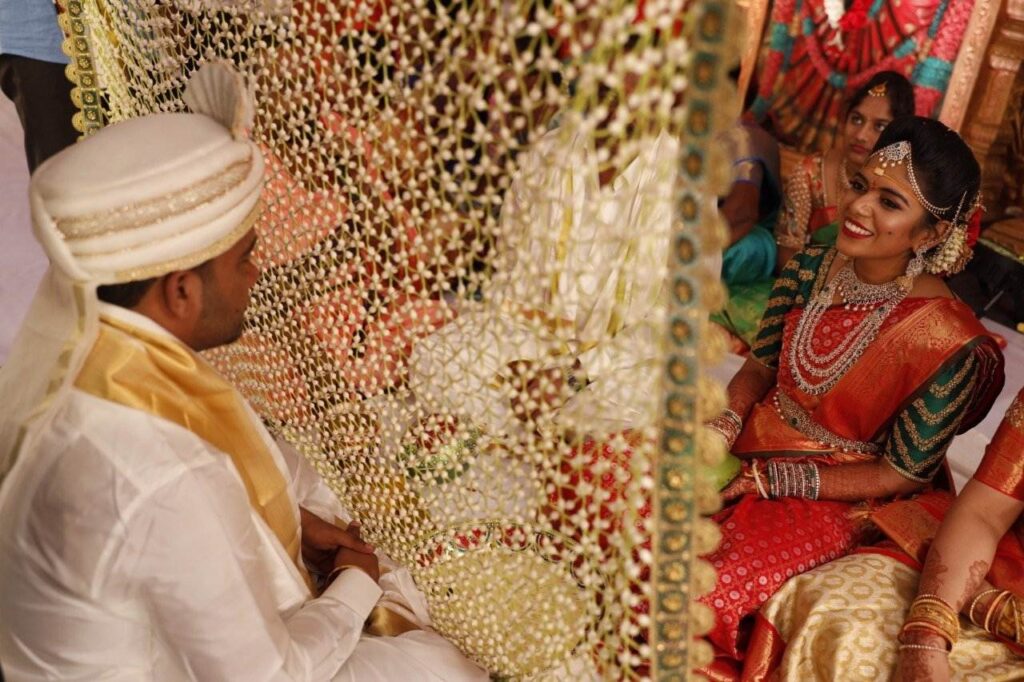
- Addutera: A decorated silk or cotton curtain held between the bride and groom by family members, preventing them from seeing each other until the exact Sumuhurtham moment.
- Decorated Kobbari Bonda: Raw, unpeeled coconuts custom-carved or painted with images of Lord Ganesha, Goddess Lakshmi, or intricate floral art, carried by the bride during her entry.
- Talambralu Basins and Trays: Carved brass or silver bowls containing pearls, colorful rice, or flower petals mixed with turmeric and ghee for the playful Talambralu ritual.
- Kanyadaan Plate: A large, silver-plated brass tray used during the ceremonial hand-washing and bride hand-off by her parents.
5. Fresh Floral Accessories and Decor Enhancements
Flowers play a functional role in Telugu ceremonies, serving as sacred offerings, body accents, and symbols of welcome.
- Poola Jada: A fresh flower braid piece woven with jasmine, roses, and marigolds attached along the bride’s hair. Modern variations feature net-based floral weaves or artificial lightweight bases.
- Gaja Malalu: Heavy, closely woven garlands made of fresh orchids, roses, or lotus buds used during the garland exchange (Kalyanam).
- Poola Banti & Floral Balls: Decorative flower balls held by the bride or used during stage entry processions.
Complete Checklist by Ceremony Phase
Use this comprehensive checklist to prepare your accessories for each distinct function.
[Pellikuthuru / Pellikoduku] ──> [Snanakalu & Mehendi] ──> [Sumuhurtham / Wedding] ──> [Talambralu & Reception]

1. Pellikuthuru / Pellikoduku Phase (Pre-Wedding Nalugu)
- [ ] Turmeric paste (Pasupu) bowls and wooden applicators
- [ ] Traditional yellow/orange cotton attire for bride and groom
- [ ] Initial Poola Jada or lightweight floral jewellery set
- [ ] Brass oil lamps (Kamakshi Deepam) with cotton wicks and oil
- [ ] Betel leaves, areca nuts, and banana bunches for elderly guest offerings
2. Main Sumuhurtham Ritual Phase
- [ ] Primary Kanjeevaram silk saree (Bride) & Silk Pancha-Kanduva (Groom)
- [ ] Complete gold jewelry set (Vaddanam, Kasu Haram, Papidi Billa, Mattilu)
- [ ] Pustelu (dual gold Mangalsutra discs) with yellow sacred thread
- [ ] Addutera curtain cloth (embroidered or hand-painted)
- [ ] Carved Kobbari Bonda (coconuts)
- [ ] Pre-mixed Jeelakarra Bellam paste on fresh betel leaves
- [ ] Silver toe rings (Metti) for the groom to place on the bride
3. Talambralu and Post-Wedding Phase
- [ ] Secondary lightweight silk saree for the bride
- [ ] Color-dyed Talambralu rice, pearls, or floral petals (minimum 5–8 kg)
- [ ] Silver or brass Talambralu pouring cups (Kopa)
- [ ] Ring-finding game vessel (wide brass vessel filled with milk, rose petals, and water)
- [ ] Ring or small coin for the vessel game
4 Common Myths About Telugu Wedding Accessories
Myth 1: “The Poola Jada must be made entirely of fresh flowers on the morning of the wedding.”
Fact: Full fresh-flower Poola Jadas can become quite heavy (weighing up to 1.5 kg) and may wilt under warm stage lights. Today, many brides opt for lightweight artificial or micro-flower bases paired with fresh jasmine borders. This structure reduces weight while keeping the flowers looking fresh throughout the ceremony.
Myth 2: “All gold jewelry must be worn all at once for every ceremony.”
Fact: Wearing every heirloom piece across multi-day events can cause physical discomfort and restricts movement during active rituals like the Talambralu. Experienced stylists recommend choosing 2 or 3 anchor pieces per ceremony—such as focusing on a Guttapusalu and Vaddanam for the main Muhurtham, while switching to lighter heritage chokers for pre-wedding rituals.
Myth 3: “Any raw rice works for the Talambralu ritual.”
Fact: Standard raw rice can feel sharp when poured over the head repeatedly during the Talambralu. Traditional preparations use high-quality, polished round-grain rice mixed with a small amount of ghee, turmeric, or natural colors. This ensures the grains fall smoothly without causing skin irritation.
Myth 4: “The Addutera curtain can be held by anyone available on stage.”
Fact: Culturally, the Addutera should be held by maternal uncles (Maternal Uncles/Mamas) or close family brothers. Assigning this task ahead of time prevents confusion on stage right before the Sumuhurtham.
Real-World Accessories Management Scenarios
Scenario 1: Managing Stage Prop Logistics in a Large Hyderabad Convention Hall
- The Context: A family organizing a 600-guest Telugu wedding at a convention venue in Madhapur realized 45 minutes before the Sumuhurtham that the Jeelakarra Bellam paste plate and Addutera curtain were still packed in a vehicle in the parking lot.
- The Preparation Solution: During their pre-wedding planning, the family had assigned an accessories kit to a dedicated family logistics coordinator. Using a master accessories checklist, the coordinator quickly retrieved the pre-labeled “Mandap Kit” container, delivering the items to the priest 20 minutes ahead of schedule.
- Outcome: The ceremony proceeded seamlessly without delaying the exact Sumuhurtham window.
Scenario 2: Preventing Heavy Jewelry Discomfort During Long Ceremonies
- The Context: A bride wearing a heavy gold Vaddanam and long temple Jhumkas began experiencing lower back discomfort and ear lobe pain during her 3-hour morning ceremony.
- The Preparation Solution: The bride had packed a bridal comfort kit containing elastic waist extenders, clear surgical tape for the earlobe backs, and lightweight fabric padding inside her jewelry case. Her stylist added discreet padding to the inner buckle of her waist belt and secured the earring chains higher in her hair.
- Outcome: The bride completed her ceremony comfortably and without skin irritation.
What to Look for When Finalizing Your Checklist
To ensure your accessories management runs smoothly, keep these practical points in mind:
Step 1: Audit Heirloom Jewelry ──> Step 2: Assign Stage Kits ──> Step 3: Secure Floral Delivery
   (3 Months Prior)                   (2 Weeks Prior)                 (1 Day Prior)
- Conduct a Jewelry & Fitting Audit Early: Try on all necklaces, waist belts, and armbands with your stitched blouse at least 3 weeks before the wedding. Verify that necklines don’t overlap with short chokers and that armbands don’t pinch.
- Organize Items in Labeled, Color-Coded Pouches: Avoid packing everything into a single large bag. Divide your accessories into clear, labeled pouches by ceremony (Pellikuthuru, Muhurtham, Talambralu).
- Establish a Dedicated Safe Zone: Assign a secure room at the venue with a locked safe for storing precious gold items like the Pustelu, Vaddanam, and cash gifts. Entrust the key to a designated family member.
- Partner with Full-Service Event Coordinators: When coordinating complex multi-day events, working with experienced teams simplifies venue setups. Hyderabad-based companies like Prashasta Events (prashastaevents.com) manage stage prop logistics, floral deliveries, and pooja samagri setups under a single point of contact, helping avoid last-minute delays.
Frequently Asked Questions
What are the most essential bridal jewelry accessories for a Telugu wedding?
The core Telugu bridal jewelry checklist includes the Vaddanam (waist belt), Papidi Billa/Nethichutti (maang tikka), Kasu Haram (gold coin necklace), Jhumkas with side Mattilu chains, Nose Ring (Nath), and Metti (silver toe rings).
What specific items are required for the Jeelakarra Bellam ceremony?
The Jeelakarra Bellam ritual requires a paste made from crushed cumin seeds (jeelakarra) and unrefined jaggery (bellam), served on two fresh betel leaves (tamalapaku) placed in a ceremonial silver or brass plate.
Where can you source authentic Telugu wedding accessories in Hyderabad?
Authentic accessories, fresh floral poola jada, carved coconuts, and traditional pooja samagri in Hyderabad are commonly sourced from specialized wedding markets in General Bazaar (Secunderabad), Laad Bazaar (Charminar), and retail stores along Road No. 36 in Jubilee Hills.
What is included in a traditional Telugu Kanyadaan tray?
A traditional Kanyadaan tray contains a silver vessel with holy water, turmeric roots (pasupu), kumkum, raw rice mixed with turmeric (akshatalu), fresh betel leaves with areca nuts, and the Mangalsutra (Pustelu).
What is a Poola Jada and when is it worn by a Telugu bride?
A Poola Jada is a traditional hair accessory woven with fresh flowers like jasmine, rose petals, and marigolds attached along a long hair braid, typically adorned with gold hair clips (Billalu). It is worn during the Pellikuthuru ritual and the main Muhurtham ceremony.
How far in advance should pooja samagri and ceremonial coconuts be ordered?
Perishable items like decorated raw coconuts (Kobbari Bonda), fresh flower garlands, and Poola Jada should be ordered 2 to 3 weeks in advance for delivery on the wedding morning. Non-perishable brass utensils, silk cloths, and wooden props can be purchased 1 to 2 months prior.
What essential accessories does the Telugu groom need during the Muhurtham?
The Telugu groom requires a silk Kanduva (stole) and Dhoti (Pancha), Uttareeyam, silver toe rings (Metti for groom ceremony exchange), a Pelli Pusthakam or ceremonial wooden staff (for Kasi Yatra), and a hand-woven silk turban or headpiece.
What is the difference between real gold and rental temple jewelry for weddings?
Real gold temple jewelry offers authentic weight and lasting family heirloom value but requires strict security logistics. Rental temple jewelry uses silver or silver-alloy bases with gold plating, offering a lightweight, cost-effective alternative for multi-day events like Sangeet or Mehendi without security risks.
Organizing a Telugu wedding accessories checklist is a meaningful way to honor heritage traditions while keeping multi-day celebrations running smoothly. By categorizing your jewelry, textiles, pooja samagri, and stage props into dedicated ceremony kits, you protect precious family heirlooms and eliminate last-minute stress. Armed with this understanding, you are well positioned to approach your wedding celebrations with clarity, poise, and confidence.





Leave a Comment