
Table of Contents
What Is Thali in South Wedding in Hyderabad? A Complete Cultural and Planning Guide
Understanding what is thali in south wedding in Hyderabad goes far beyond viewing it as a piece of traditional bridal jewelry. Locally revered as Pustelu, Sathamanam, or Mangalsutram, the Thali is the central spiritual emblem of marriage across Telugu, Tamil, Kannada, and Malayali households in Telangana’s capital. Strung onto a sacred turmeric-coated cotton thread (Pasupu Thadu), these 22-karat gold discs are tied around the bride’s neck with three firm knots during the exact Shubha Muhurtham window. For couples and event organizers planning celebrations in Hyderabad—whether at a heritage kalyana mandapam in Secunderabad or a convention hall in Gachibowli—coordinating the sourcing, blessing, and stage execution of this ritual requires careful cultural accuracy and timing discipline.
Last Updated: November 2026

What Is a Thali in a South Indian Wedding?
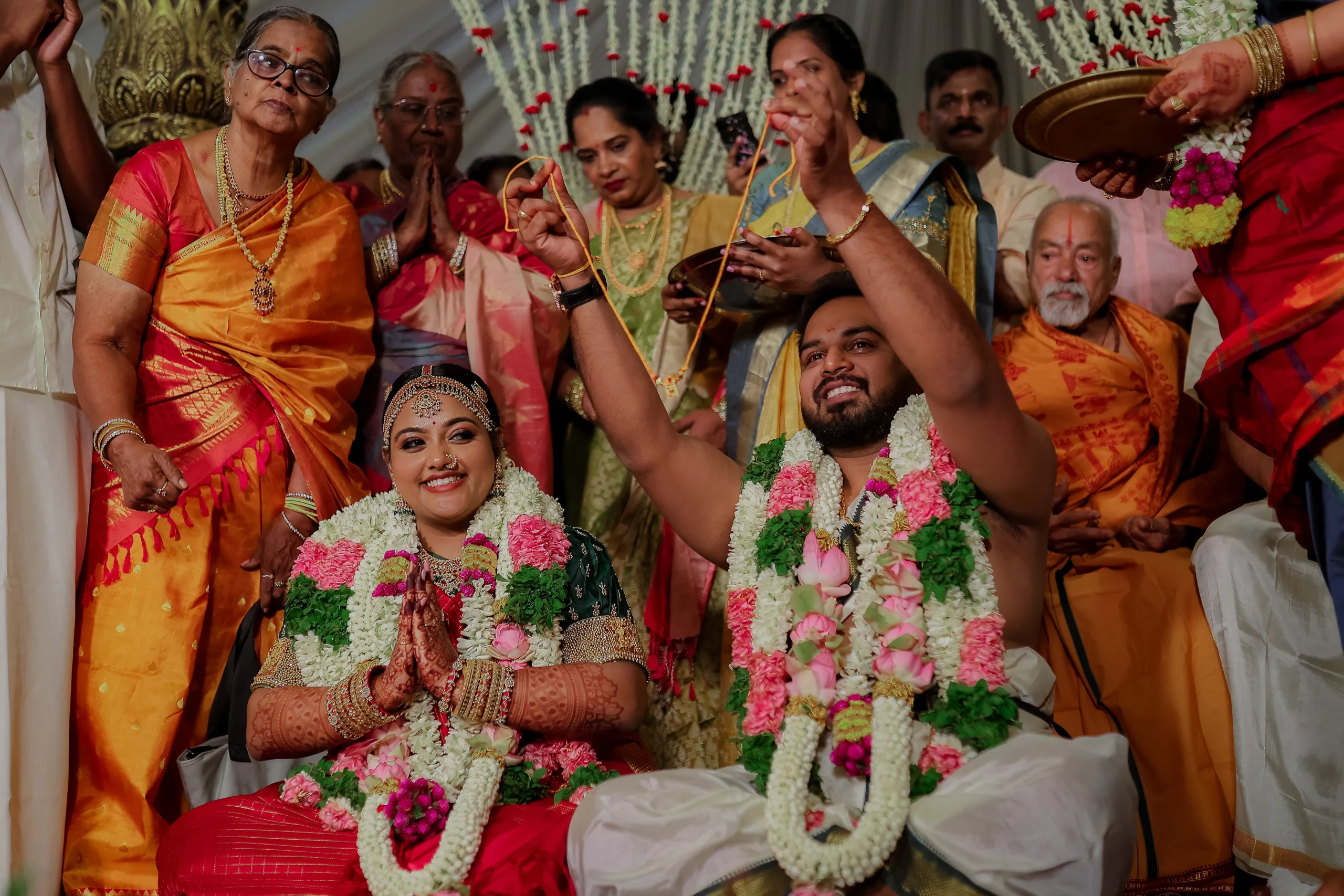
In a South Indian wedding in Hyderabad, the Thali (locally called Pustelu or Mangalsutram) is a sacred 22-karat gold pendant strung on a turmeric-dyed cotton thread (Pasupu Thadu). During the auspicious Muhurtham, the groom ties it around the bride’s neck with three knots to formalize their lifelong spiritual and legal union.
Structurally and ceremonially, the Thali ritual anchors the entire wedding schedule across three distinct stages.
3 Stages of the Thali Ceremony in Hyderabad
1. Pre-Wedding Preparation
- Arranging the two 22K gold discs.
- Preparing the turmeric thread (Pasupu Thadu).
2. Wedding Ceremony
- Elders give their blessings.
- The groom ties the Mangalsutra with three knots during the wedding ceremony.
- Traditional drums and wedding rituals accompany the ceremony.
3. Post-Wedding Ritual (16th Day)
- The Padaharu Rojula Panduga is celebrated.
- The gold discs are transferred or restrung onto a gold chain as part of the family tradition.
Why Families Mismanage Thali Logistics During Hyderabad Weddings
Even when families deeply respect tradition, live stage execution around the Thali ritual frequently hits avoidable snags on wedding day.
- Leaving Safe Custody Ambiguous Before the Muhurtham: Because gold Pustelu carry high financial and sentimental value, families often lock them inside a hotel safe or suitcase without telling the stage coordinator, triggering frantic 15-minute searches right before the Siddhanti (priest) calls for the tray.
- Overlooking Dual-Family Disc Coordination: In Telugu weddings, one gold disc typically comes from the groom’s side and the second from the bride’s side. Failing to match disc diameters and weight weeks in advance results in uneven pendants when threaded together.
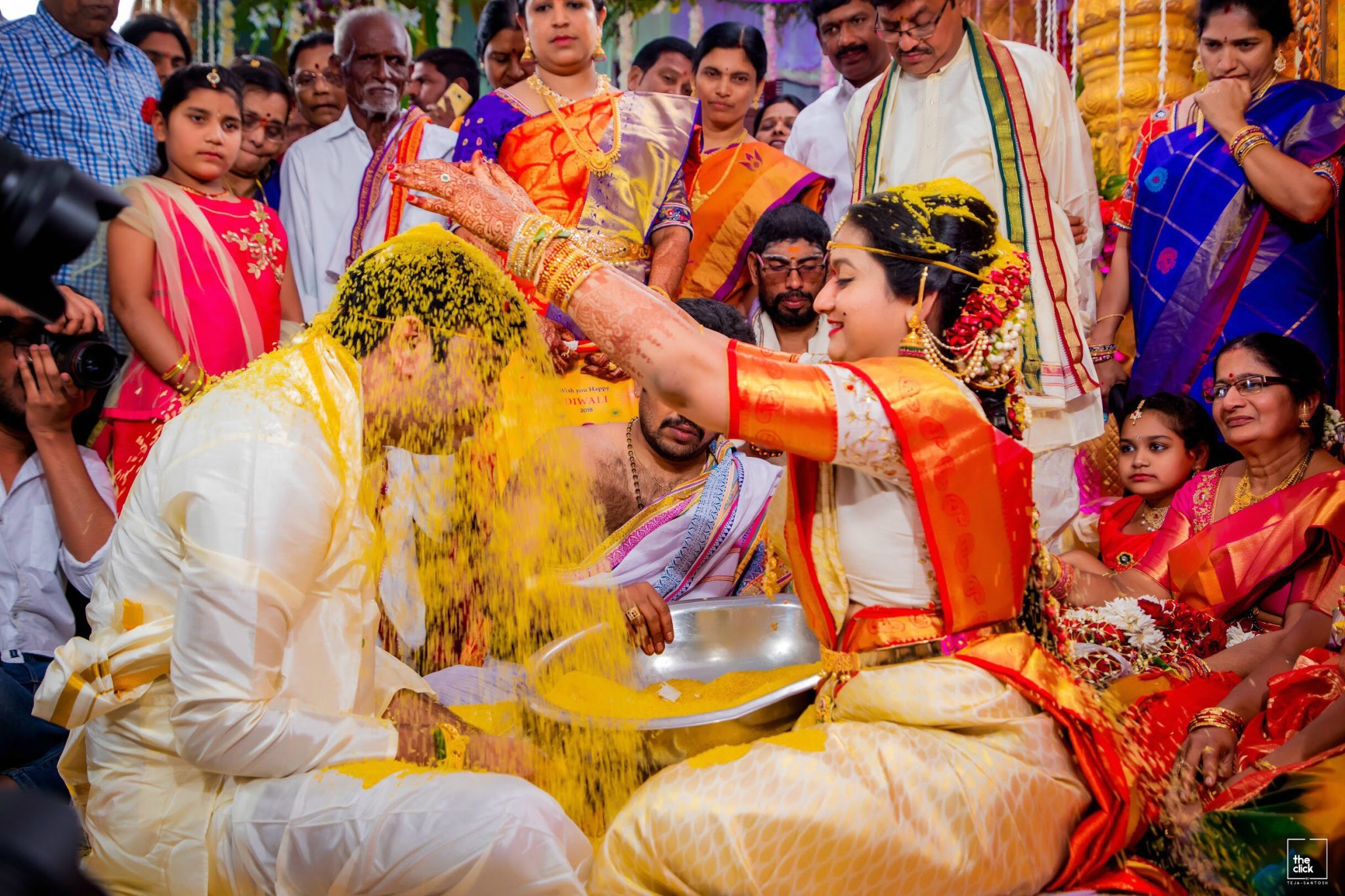
- Blocking Photography Angles During the Three Knots: When 25 relatives crowd onto the wedding mandap simultaneously to throw Akshinthalu (turmeric rice) during Mangalsutra Dharana, photographers lose clear sightlines to capture the groom tying the knots.
5 Core Cultural and Structural Elements of the South Indian Thali
Understanding the exact anatomy of a South Indian Thali helps couples and planners prepare the right ritual items without last-minute confusion:
1. Dual 22-Karat Gold Discs (Sathamanam)
Unlike single-pendant chains common in northern India, a traditional Telugu Thali features two distinct round or slightly concave gold discs. One disc represents the groom’s lineage and the other represents the bride’s lineage, symbolizing two families merging into one household.
2. Nine-Strand Turmeric-Coated Cotton Thread (Pasupu Thadu)
Gold chains are rarely used during the actual ceremony. Instead, jewellers or family elders twist nine thin cotton strands together and coat them generously in pure turmeric paste (Pasupu) and kumkum, harnessing turmeric’s traditional antimicrobial and auspicious properties.
3. Coral and Black Bead Spacers
Between the two gold discs, artisans place small gold tubular spacers alongside natural red coral (Pagadam) and black glass beads (Nallapusalu). These elements are believed to balance planetary energies and ward off negative attention (Drishti).
4. Traditional Coconut or Silver Blessing Platter
On the wedding stage, the Thali is never handed over loose. Priests place it atop a fresh whole coconut smeared with turmeric or inside a silver plate lined with betel leaves, bananas, jasmine flowers, and sacred rice.
5. The Three-Knot Tying Protocol
Tying the Thali involves three deliberate knots symbolizing commitment in thought (Manasa), word (Vacha), and deed (Karmana). The groom ties the first two knots while Vedic chants peak, and the groom’s sister (Aadapaduchu) steps in to tie the third knot.
Regional Thali Variations Found Across Hyderabad
Because Hyderabad is home to diverse South Indian communities, the exact visual design of the Thali varies depending on family heritage:
| Community Tradition | Local Term | Distinguishing Visual Design | Typical Gold Weight (Discs Only) |
| Telugu (Telangana & Andhra) | Pustelu / Sathamanam | Two matching round or cup-shaped gold discs separated by coral and gold beads | 10g – 24g (1 to 2 tulas) |
| Tamil (Iyer / Iyengar / Mudaliar) | Thirumangalyam | Single intricately sculpted gold pendant featuring sacred Tulsi, Pillaiyar, or Vaishnavite emblems | 8g – 20g |
| Kannada (Vokkaliga / Lingayat) | Mangalya / Thaali | Dual gold discs paired with twin conical gold beads (Gundu) and black bead strands | 12g – 24g |
| Malayali (Nair / Syrian Christian) | Minnu | Leaf-shaped or heart-shaped gold pendant featuring a tiny beaded cross or sacred engraving | 4g – 10g |
How Much Does a Wedding Thali Cost in Hyderabad?
Budgeting for a Thali in Hyderabad depends on prevailing 22-karat gold rates, custom artisan making charges, and whether the family also purchases a heavy gold chain for post-wedding wear.
Typical Thali Budget Options in Hyderabad
– Traditional Gold Discs Only (10g–16g): ₹85,000–₹1,45,000
- Includes 22K gold discs, turmeric thread, making charges, and GST.
– Gold Discs with Medium Gold Chain (32g–45g): ₹2,75,000–₹3,90,000
- Includes gold discs and a medium-weight chain for the 16th-day ritual.
– Heavy Traditional Gold Set (50g–70g+): ₹4,30,000–₹6,00,000+
- May include Nallapusalu and Kasulaperu designs.
- Sourcing the Discs: In traditional Telugu families, the groom’s parents purchase the primary gold disc and thread, while the bride’s maternal uncle (Menamama) or parents gift the matching second disc.
- Gold Purity Standards: Experienced jewellers across Abids, Panjagutta, and Somajiguda recommend 22-karat (916 BIS Hallmarked) gold rather than 24-karat gold, as pure 24K gold is too soft to hold sharp engravings or withstand daily wear.
Step-by-Step Guide: How to Prepare and Execute the Thali Ceremony
Follow this 6-step operational workflow to ensure the Thali ceremony unfolds smoothly from jewelry counter to wedding mandap:
1.Step 1: Confirm Community-Specific Thali Designs: Verify regional disc motifs with elders.
Meet with elders from both sides 2 months prior to confirm exact pendant symbols, disc diameters, and which family side is commissioning each disc.
2.Step 2: Commission Custom Gold Discs 6 Weeks Out: Order 22K BIS hallmarked gold early.
Place orders at a certified Hyderabad jeweller at least 6 weeks before the wedding, allowing extra time for traditional hand-engraving and hallmark verification.
3.Step 3: Prepare the Sacred Pasupu Thadu: Coat nine cotton strands in pure turmeric.
One day before the ceremony, prepare a sturdy nine-strand cotton thread coated in organic turmeric paste and kumkum, testing its length so the groom can tie knots comfortably.
4.Step 4: Arrange the Blessing Tray on the Mandap: Assemble the silver blessing platter.
Assign one designated family member to bring the Thali from safe storage 30 minutes before the Muhurtham and place it on a coconut or silver tray with betel leaves and flowers.
5.Step 5: Circulate the Thali for Elder Blessings: Circulate the tray for blessings.
Before the auspicious minute, have the priest and senior elders touch the Thali tray to offer blessings while Nadaswaram and Thavil musicians build ceremonial tempo.
6.Step 6: Execute the Three-Knot Mangalsutra Dharana: Coordinate stage space for the three knots.
Immediately after Jeelakarra Bellam, clear the front stage angle for photographers as the groom ties two knots and his sister secures the third knot amid showers of Akshinthalu.
4 Common Myths About the South Indian Thali
Myth 1: “The groom ties all three knots of the Thali by himself.”
Fact: In almost all Telugu and Tamil wedding customs, the groom ties the first two knots while reciting sacred vows, and the groom’s sister (Aadapaduchu) steps forward to tie the third knot as a formal gesture welcoming the bride into the family.
Myth 2: “The bride wears a heavy gold chain during the main Muhurtham.”
Fact: During the actual wedding ceremony, the gold Pustelu are always strung on a turmeric-dyed cotton thread (Pasupu Thadu). Switching the pendants onto a gold chain happens 16 days later during a separate home ceremony.
Wedding Day Thread vs. 16th-Day Gold Chain
1. Wedding Day – Pasupu Thadu
- A nine-strand cotton thread is dipped in turmeric and kumkum.
- The groom ties it around the bride’s neck with three knots during the wedding ceremony.
- The bride traditionally wears it for 16 days.
2. 16th Day – Gold Chain Ceremony
- The ritual takes place during Padaharu Rojula Panduga, usually with the family priest.
- The gold discs are transferred to a 22K gold chain.
- The turmeric thread is respectfully removed as part of the family tradition.
Myth 3: “Any off-the-shelf gold pendant works as a wedding Thali.”
Fact: Each South Indian community has distinct iconography—ranging from plain convex discs to specific Shaivite or Vaishnavite emblems. Using an unverified generic pendant often violates elder expectations on the wedding stage.
Myth 4: “The Thali ritual takes 30 minutes on stage.”
Fact: While pre-ritual blessings and Vedic chanting build up over 20 minutes, the actual tying of the three knots takes less than 90 seconds. Without proper photographer positioning and crowd control, media teams can easily miss the shot.
Real-World Stage Coordination Scenarios in Hyderabad
Scenario 1: A 450-Guest Traditional Telugu Wedding in Secunderabad
- The Challenge: An early-morning 4:45 AM Muhurtham meant the family stayed in hotel rooms across the street from the kalyana mandapam, creating security concerns over transporting the gold Thali and bridal jewelry.
- The Strategy: The family assigned a single “Jewelry & Ritual Custodian” (the bride’s elder cousin) who kept the Thali tray inside a locked portable pouch, delivering it directly to the Siddhanti on stage at 4:15 AM.
- The Outcome: The priest blessed the tray on schedule, and the 4:45 AM Jeelakarra Bellam and Mangalsutra Dharana proceeded without a single minute of delay.
Secunderabad Wedding Thali Ceremony – 4:45 AM Schedule
- 4:00 AM – Thali Collection: The person responsible collects the Thali from the hotel safe.
- 4:15 AM – Thali Preparation: The Thali is placed on a silver coconut tray with the Siddhanti (priest).
- 4:30 AM – Elders’ Blessings: Elders bless the Thali, and the front of the stage is cleared for photography.
- 4:45 AM – Main Wedding Ritual: Jeelakarra Bellam is performed, followed by tying the Thali with three knots.
- 4:50 AM – Wedding Blessings: Nadaswaram music reaches its peak, and guests shower Akshinthalu (blessed rice) on the couple.
Scenario 2: An Inter-Community Telugu-Tamil Wedding in Gachibowli
- The Challenge: A Telugu groom marrying a Tamil bride wanted to honor both families’ sacred symbols without crowding the bride’s neckline.
- The Strategy: Working with a custom jeweller in Panjagutta, the families commissioned a single unified Pasupu Thadu featuring the Tamil Thirumangalyam pendant centered between two smaller Telugu Sathamanam gold discs.
- The Outcome: Both sets of elders felt deeply respected during the blessing ceremony, and the unified piece balanced cleanly during photography.
Pre-Ceremony Thali Verification Checklist
Review this practical checklist with your family elders and stage coordinator 48 hours before the wedding:
- [ ] Dual Disc Match Check: Have both families verified that their respective gold discs match in karat purity, diameter, and hole threading size?
- [ ] Turmeric Thread Preparation: Is the nine-strand Pasupu Thadu freshly coated in turmeric, dried properly so it doesn’t stain bridal silk excessively, and long enough for easy knot-tying?
- [ ] Custody & Vault Plan: Is one named family member responsible for holding the Thali tray and handing it to the priest 30 minutes prior to the Muhurtham?
- [ ] Stage Crowd Control: Have elders agreed to keep the front 6 feet of the mandap clear during Mangalsutra Dharana so photographers and videographers have unobstructed angles?
- [ ] Nadaswaram & Audio Cue: Is the stage coordinator briefed to signal traditional musicians (Gatti Melam) the exact second the groom picks up the Thali?

Frequently Asked Questions
What is thali in south wedding in Hyderabad?
In a South Indian wedding in Hyderabad, the Thali (locally known as Pustelu or Mangalsutram) is a sacred gold pendant strung on a turmeric-dyed cotton thread (Pasupu Thadu) or gold chain. The groom ties it around the bride’s neck with three knots during the Muhurtham to formalize their marriage.
Why are there two gold discs in a Telugu wedding Thali?
In Telugu traditions, a Thali typically features two distinct gold discs (Sathamanam or Pustelu). One disc is provided by the groom’s family and the second by the bride’s family, symbolizing the equal union and mutual blessing of both lineages.
How much gold is typically used for a wedding Thali in Hyderabad?
The gold discs alone generally weigh between 8 grams and 24 grams (1 to 3 tulas) of 22-karat gold, depending on family tradition. If strung on a solid gold chain instead of a turmeric thread, total gold weight ranges from 30 to 60 grams.
Who ties the third knot of the Thali in South Indian weddings?
During Mangalsutra Dharana, the groom ties the first two knots while chanting Vedic vows, and the groom’s sister (Aadapaduchu) steps forward to tie the third knot, welcoming the bride into her new family.
When is the turmeric thread replaced with a gold chain?
In Telugu customs, the bride wears the original turmeric-coated cotton thread (Pasupu Thadu) for 16 days after the wedding. On the 16th day (Padaharu Rojula Panduga), families perform a ritual to transfer the gold discs onto a permanent gold chain.
How do event planners coordinate the Thali ritual on stage?
Experienced planners assign a designated ritual coordinator to secure the Thali tray in a locked vault until 30 minutes before the Muhurtham, brief photographers on stage angles, and cue Nadaswaram players during the three-knot tying.
What is the difference between a Telugu Pustelu and a Tamil Thirumangalyam?
A Telugu Pustelu features two separate round or curved gold discs separated by coral and black beads, whereas a Tamil Thirumangalyam typically consists of a single intricately engraved pendant motif representing specific community deities.
What happens if the Thali thread breaks accidentally?
If a cotton Pasupu Thadu frays or breaks, families consult their priest (Siddhanti) to pick an auspicious day to restring the gold discs onto a fresh turmeric-coated thread accompanied by simple home prayers.
Understanding what is thali in south wedding in Hyderabad brings clarity to both the spiritual meaning and the practical stage logistics behind South India’s most revered marriage ritual. By commissioning authentic 22-karat discs early, preparing the Pasupu Thadu properly, assigning a dedicated stage custodian, and clearing sightlines for the three-knot tying, families can honor centuries-old tradition without last-minute rush. Armed with this understanding, you are well positioned to coordinate a seamless, deeply meaningful ceremony.



Leave a Comment